

🌍 The Week in International Sport
Monday June 1st: volleyball ratings, test cricket's popularity and Ivar Stenberg

This year at Plot the Ball, I’m using data to try and better understand the landscape of international team sport. For some background to this project — which I’m calling ‘Rank the Nations’ — you can read my introductory post here.
In today’s edition of The Week in International Sport:
🇵🇱 Poland leading the way in men’s volleyball
🇮🇹 Italy leading the way in women’s volleyball
🇫🇮 Finland winning a world title in men’s ice hockey
📊 Chart of the week: assessing the global popularity of test cricket
⏪️ Highlight of the week: Ivar Stenberg’s show-stopper
💭 A few other interesting things I learned
As a reminder: the team ratings used in this newsletter are on a zero-to-10 scale, and are calculated based on a nation’s performance in competitive fixtures in a given sport since the start of the 2022 calendar year. (For more detail, click here.)
🇵🇱 Poland lead the first edition of the men’s volleyball ratings
Volleyball — the indoor version, that is — was the only ‘net sport’ to make the cut for this project. (As an aside: I’ve not included beach volleyball, as it’s contested by pairs of players rather than ‘national teams’ — even at events like the Olympic Games.)
The nature of these sports is such that top competitors can squeeze an exceptionally high win rate out of a seemingly small advantage at the level of individual points. So it is with Poland (6.7), who are the dominant team in men’s international volleyball at present. They have won just 53% of their points in competitive play since 2022 — but 82% of their matches. That’s been enough to bring in a tidy haul of medals during this period: two Nations League golds and an Olympic silver, among several others.
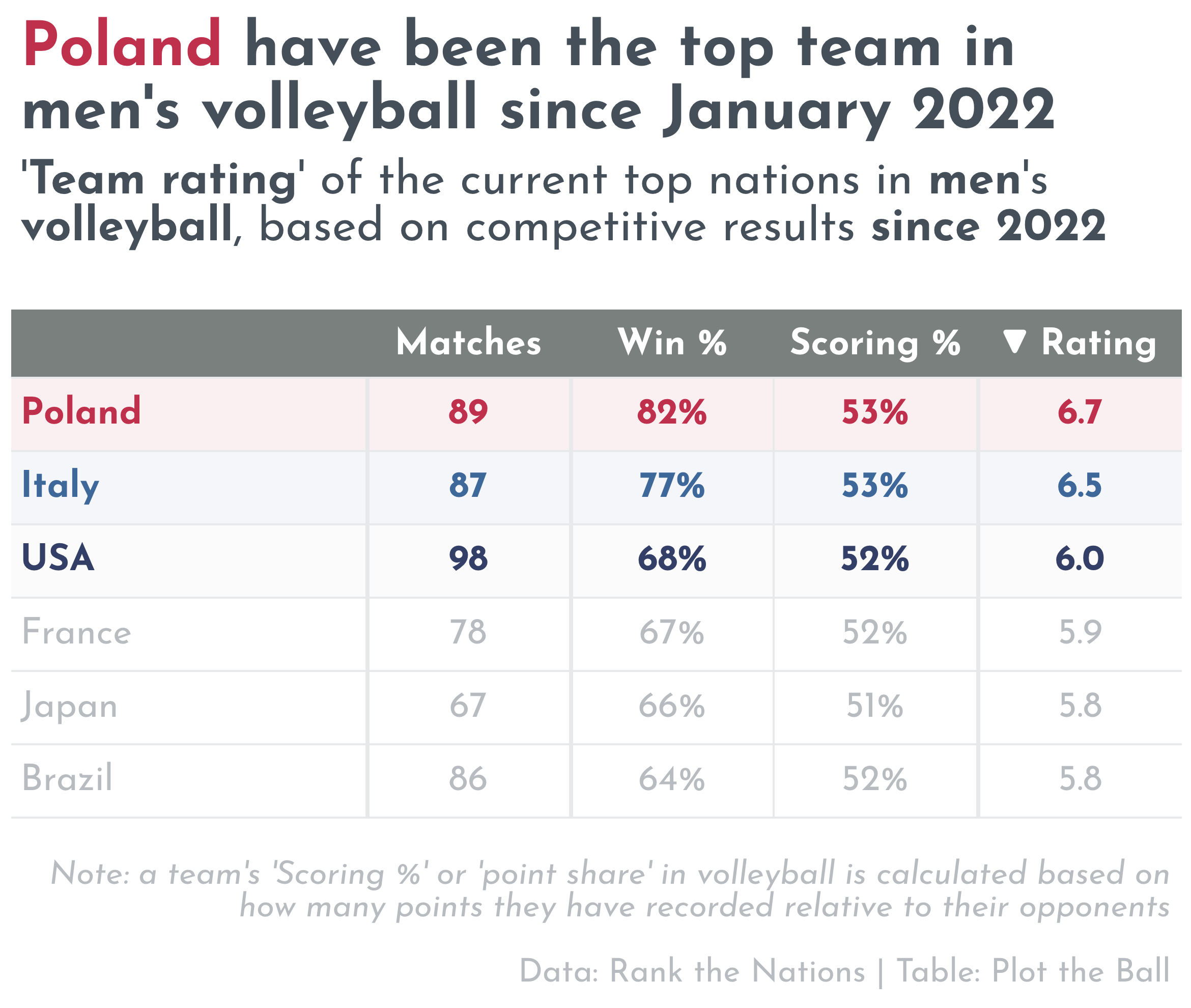
Second-ranked Italy (6.5) have won points at a similar rate to their rivals, but have fewer outright wins to show for it. The result of this trend is a serious squeeze in the middle of the pack. 20 nations have played enough men’s volleyball matches over the last five years to qualify for the rankings above; 17 of those 20 teams have won between 48% and 52% of their competitive points since 2022, and currently have a ‘Rank the Nations’ rating between 4.0 and 6.0.
🇮🇹 Italy lead the first edition of the women’s volleyball ratings
Women’s volleyball is a little more dispersed than the men’s game: top-ranked Italy (7.0) have won 54% of their points since 2022. They currently hold three major global trophies: Olympic gold, the World Championship and the Nations League title.
When the 2026 edition begins this week, in fact, they’ll be seeking their fourth Nations League title in five years. Last year’s losing finalists Brazil (6.7) are one of Italy’s closest challengers, along with China (6.3), the USA (6.1) and Turkey (6.1).
🇫🇮 Finland win the 2026 Men’s Ice Hockey World Championship
Host nation Switzerland (5.7) had a dominant run through this year’s Men’s Worlds, winning their first nine games of the tournament by 48 goals to eight in aggregate. In yesterday’s final, however, they lost 0-1 to Finland (5.9) in sudden-death overtime.
The third-place playoff also went against recent form, as Canada (7.2) — who went unbeaten in pool play — lost 2-3 to Norway (3.9). The Nordic country’s bronze medal represents their best-ever finish in a major men’s ice hockey competition.
📊 Chart of the week: Is test cricket really that unpopular?
One sport I was surprised not to see near the top of my ‘popularity score’ rankings a few weeks ago: test cricket. That list drew on Google Trends data; to investigate further, I plotted search activity for ‘cricket’ in general — leaving formats aside.
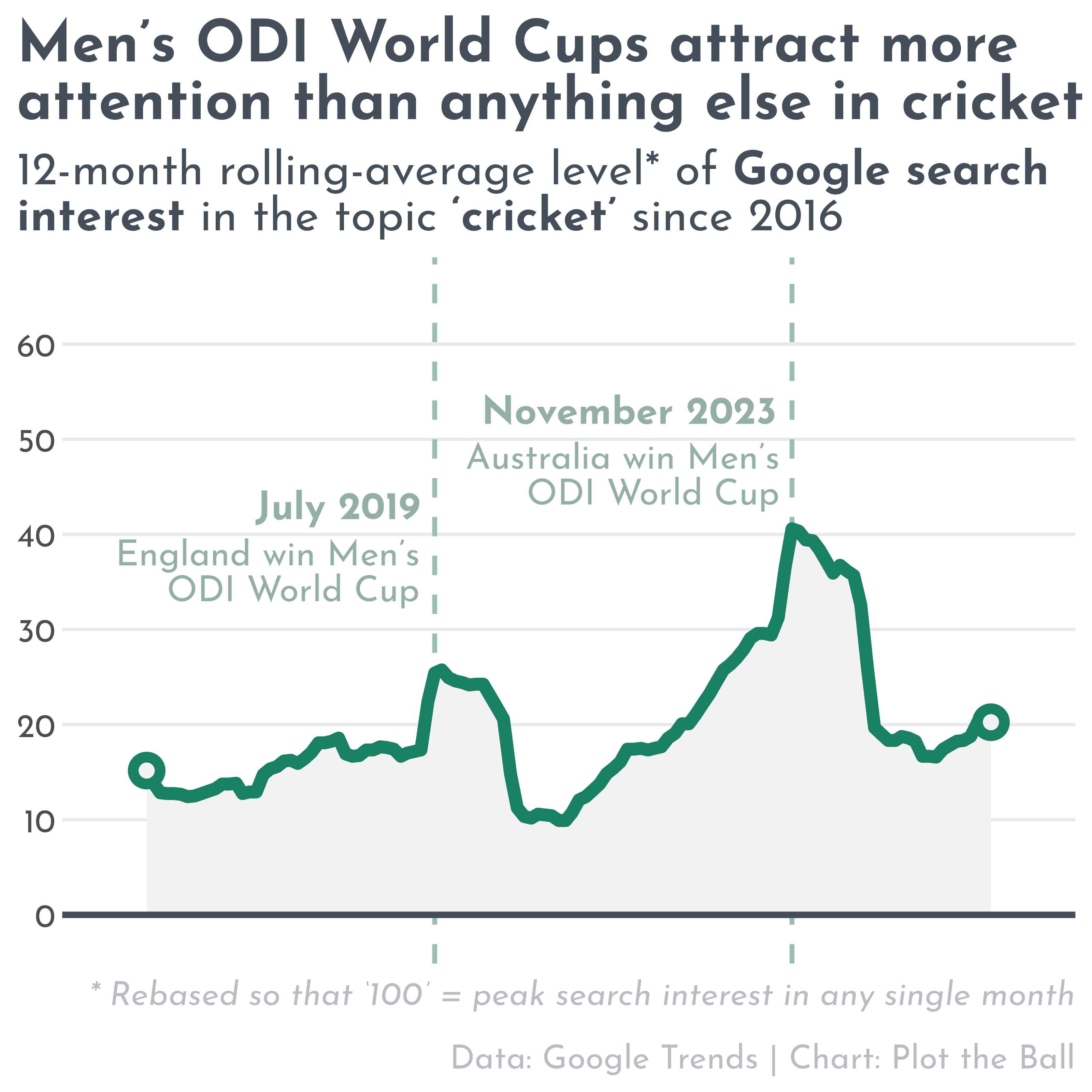
As the chart indicates, peak interest is driven by the flagship event in men’s ODI cricket: the 50-over World Cup, which takes place every four years. The World Test Championship was instituted in 2019 to provide men’s test cricket with a better competitive structure and more context for casual followers, but it doesn’t yet appear to have captured their imagination; the latest final — contested by Australia and South Africa at Lord’s during June 2025 — barely registers in the data above.
⏪️ Highlight of the week: Ivar Stenberg’s show-stopper
I try to spread out my coverage across different sports each week, and we’ve already briefly covered the latest in men’s international ice hockey. However, Ivar Stenberg’s goal for Sweden against Slovakia last Tuesday stopped me in my tracks.
The 18-year-old will be one of the top selections in this year’s NHL Draft. His skating isn’t rated that highly by scouts, but he showed real poise after carrying the puck across the blue line in the second period. The forward first angled his body towards the centre of the offensive zone; then, when the Slovak defender trailing him turned his shoulders inwards, he swivelled back into open space on his forehand side. His “high-end” shot — per The Athletic’s draft guide, at least — took care of the rest.
You can watch a replay of this goal on Instagram here.
💭 What else I learned last week
On their blog, Jesse Davis and Pieter Robberechts of the DTAI Sports Analytics Lab at KU Leuven published their predictions for the upcoming men’s soccer World Cup. No team has a better than one-in-four chance of winning the tournament outright, but Spain are the academics’ current favourites: according to their model, the winners of the 2024 European Championship have “the strongest offense and second best defense in the tournament”.
For the Sydney Morning Herald, Christian Nicolussi reported on the impact of the major changes to player eligibility instituted for the first time in this year’s men’s rugby league ‘State of Origin’ series in Australia. Players who represent other ‘tier one’ teams — New Zealand and England — in international competition are no longer barred from playing in Origin. Of those picked for last week’s series opener, “up to 15…could take on host nation Australia at this year’s World Cup”.
For his newsletter, Simon Blanford analysed how often the top nations in women’s field hockey score goals in different team-strength scenarios. During what he calls ‘unbalanced play’, the scoring rate of the ‘numbers-up’ team does increase, but the opposite effect is more pronounced. “[T]here is a general decline in goal scoring when a team loses a player…falling from about 3.5 goals a game to less than one. Effectively teams do not score when they lose a player to a card.”
The next edition of the newsletter will be published on Monday June 8th.
