

🌍 The Week in International Sport
Monday May 18th: women's ODI cricket, the pinnacle of rugby league and John Tavares

This year at Plot the Ball, I’m using data to try and better understand the landscape of international team sport. For some background to this project — which I’m calling ‘Rank the Nations’ — you can read my introductory post here.
In today’s edition of The Week in International Sport:
🇦🇺 Australia leading the way in women’s ODI cricket
🏴 England winning a European title in women’s rugby union
📊 Chart of the week: assessing the history of men’s rugby league in Australia
⏪️ Highlight of the week: John Tavares’ tournament opener
💭 A few other interesting things I learned
As a reminder: the team ratings used in this newsletter are on a zero-to-10 scale, and are calculated based on a nation’s performance in competitive fixtures in a given sport since the start of the 2022 calendar year. (For more detail, click here.)
🇦🇺 Australia lead the first edition of the women’s ODI cricket ratings
For the first time since 2018, Australia don’t currently hold the World Cup in either white-ball format of women’s cricket: neither T20Is nor ODIs. They’ll have a chance to regain the T20 World Cup this July, but it will be a longer wait in the 50-over game.
Last year’s ODI World Cup was a seminal moment, as India — a modern powerhouse of men’s cricket, at least in its white-ball formats — won their first major trophy in the women’s game. According to my rankings, however, it’s too early to declare a true shift in the balance of power in ODI cricket. Taking all competitive fixtures over the last five years into consideration, Australia (7.5) are still rated much higher than any other team. India (6.1) do sneak into second place, just ahead of England.
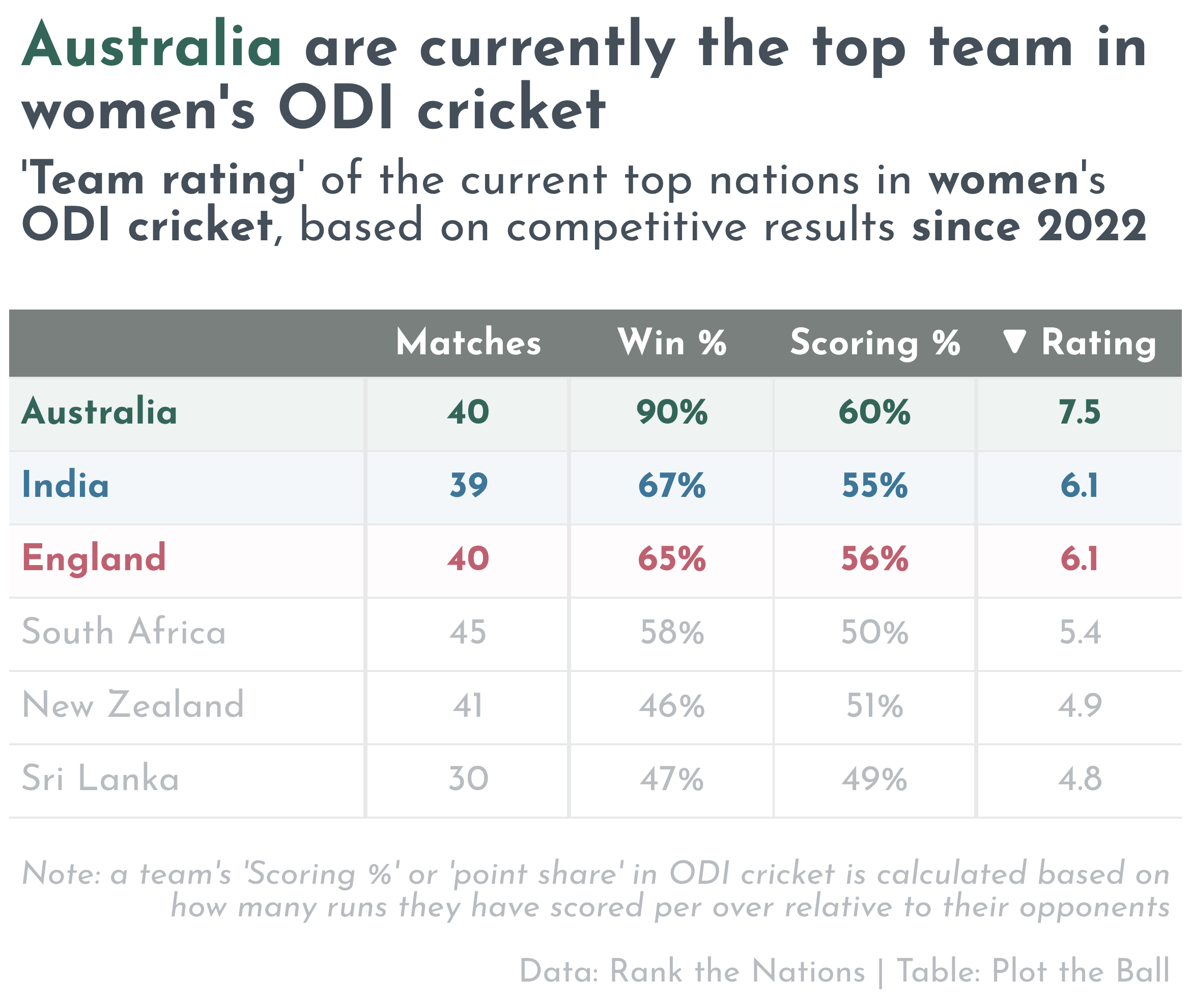
Also included in these ratings are fixtures in the ICC Women’s Championship; over a multi-year period, a set number of bilateral series between top-ranked teams count towards the IWC table. (England just hosted New Zealand in one such series.) Australia have won all three editions so far, and 88% of their IWC matches in total since 2014. No other team has won more than 65% of their fixtures during this period; when that gap begins to close, I’ll start to question whether the Aussies are still on top.
🏴 England win the 2026 Women’s Six Nations Championship
England (8.9) won their eighth consecutive European title in women’s rugby union yesterday, convincingly beating their main rivals in the competition away from home. France (6.8) have now finished second overall in seven Six Nations in a row.
How are England trending? At the end of last year, they had a 9.0 rating — so their level has actually dropped a little. Compared to 2025, other Six Nations teams scored one point per game more against them this year — and conceded three points fewer.
📊 Chart of the week: Who’s on top of men’s rugby league in Australia?
I’ve not written much about international rugby league so far this year. In fact, the highest representative honour in the sport might be selection for Australia’s ‘State of Origin’ series; per Google, global search interest is higher than it is for the World Cup.
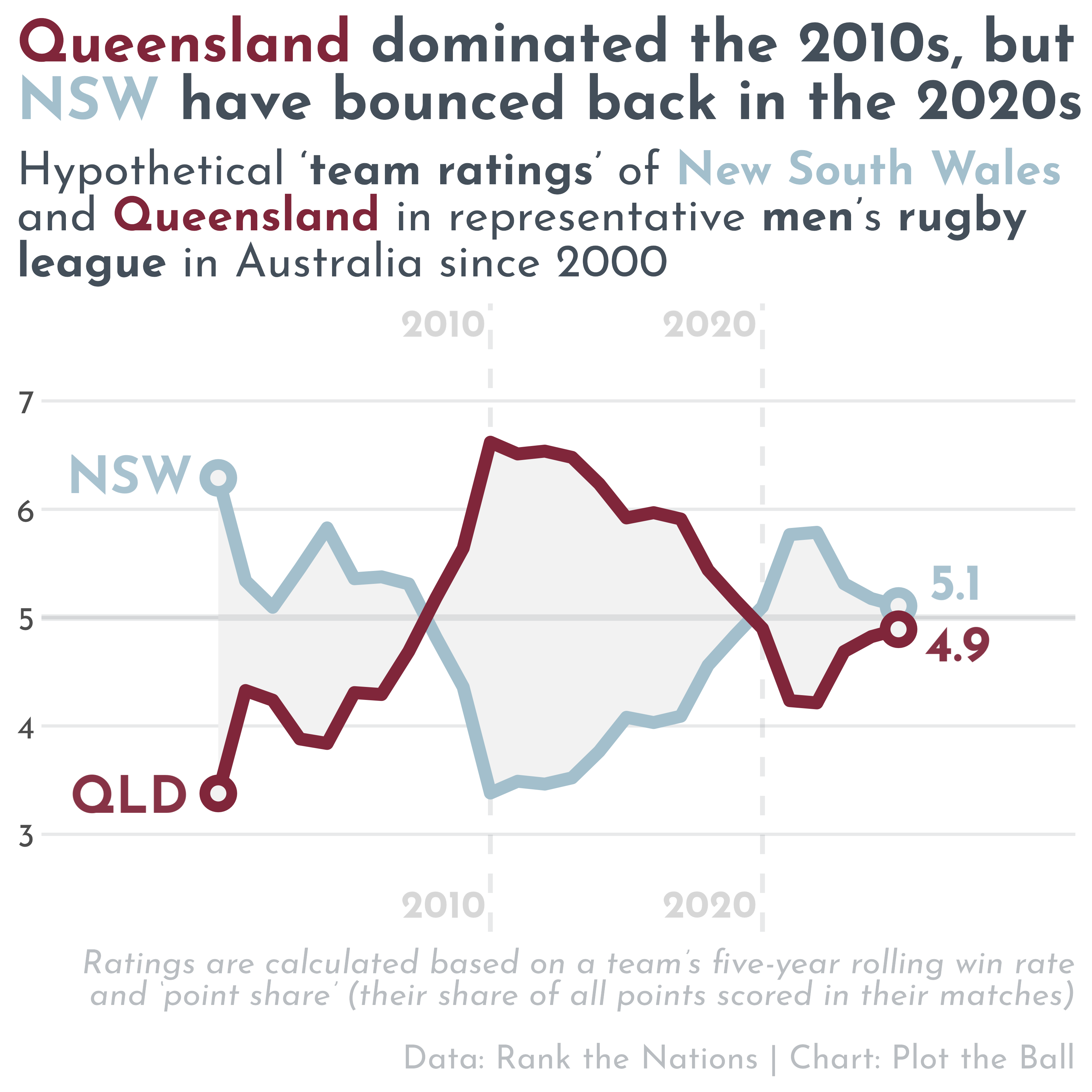
So — ahead of this year’s men’s Origin series kicking off next week — I’m cheating a bit in this edition. What would applying the methodology of ‘Rank the Nations’ to the history of rugby league matches between New South Wales and Queensland reveal? Entering 2026, the two states are almost neck and neck. While Queensland have won eight of 15 matches over the last five years, NSW remain marginally ahead as a result of scoreline dominance in their wins: all seven have come by 10 points or more.
⏪️ Highlight of the week: John Tavares’ tournament opener
One potential first-overall NHL Draft selection — 18-year-old wing Gavin McKenna — ultimately chose not to play in the men’s ice hockey World Championship this month. Still, top picks have been the centre of attention for Canada at this year’s tournament.
Macklin Celebrini (picked first in 2024) made headlines after being named captain at 19. That decision became more striking when national-team legend Sidney Crosby (2005) joined their roster late — and didn’t take his ‘C’ back from Celebrini. When the action began, however, it was John Tavares (2009) who entered the spotlight. After a teammate brought the puck up the ice early in their first game against Sweden, he broke towards the net at just the right time to receive a pass and bury a great chance.
You can watch a replay of this goal on Instagram here.
💭 What else I learned last week
For ESPNCricinfo, Osman Samiuddin contextualised Pakistan’s state of precarity in men’s test cricket after losing to Bangladesh on Monday. In his view, “on-field results feel more than ever like they're catching up to the continuing degradation in the way the game is run off it”: the national governing body — currently helmed by a sitting government minister — is burning through both chairs and head coaches, and “no annual financial statement has been made public since 2023”.
For WNBA.com, Brian Martin covered the influx of talent from overseas into the top women’s basketball league in North America. After it expanded to 15 teams for the 2026 season, a record 51 players born outside the USA have appeared on a WNBA court already this year. That number is likely to grow as the season progresses: “several players still fulfilling overseas commitments” are contracted to franchises and expected to join up with them over the next few months.
For ESPN, Sam Marsden reported on Spain’s attempts to persuade Lionel Messi to represent them — and not Argentina — in men’s international soccer during the early 2000s. Their intent set off a mad scramble inside the Argentine Football Association, culminating in an age-grade friendly being arranged to capture his eligibility. A local journalist recounts: “For [his] first Argentina call-up, the AFA sent the fax to Barcelona with his name misspelled, written ‘LEONEL MECCI’.”
The next edition of the newsletter will be published in two weeks’ time, on Monday June 1st.
