

🌍 The Week in International Sport
Monday March 2nd: field hockey, New Zealand in rugby sevens and Sam Kerr's return

This year at Plot the Ball, I’m using data to try and better understand the landscape of international team sport. For some background to this project — which I’m calling ‘Rank the Nations’ — you can read my introductory post here.
In today’s edition of The Week in International Sport:
🇳🇱 The Netherlands leading the way in women’s field hockey
🇳🇱 The Netherlands leading the way in men’s field hockey
📊 Chart of the week: assessing New Zealand’s form in women’s rugby sevens
⏪️ Highlight of the week: Sam Kerr’s return for the Matildas
💭 A few other interesting things I learned
As a reminder: the team ratings used in this newsletter are on a zero-to-10 scale, and are calculated based on a nation’s performance in competitive fixtures in a given sport since the start of the 2022 calendar year. (For more detail, click here.)
🇳🇱 The Netherlands lead the first edition of the women’s field hockey ratings
Some of the team ratings that emerge from this project inspire more confidence than others do. Performing this type of analysis has given me an appreciation for just how much more robust the international calendar is in certain team ball sports.
Of any code I’ve featured to date, field hockey might have the best-established calendar. As well as a World Cup, the Olympics and other regional tournaments, top nations play in a round-robin competition called the Pro League every year. I’m more confident that the women’s ratings below, then, give an accurate picture of relative strength than those in men’s ice hockey that I deconstructed last week. As a result, I’m also as impressed by the Netherlands (8.7) as I have been by any team so far.
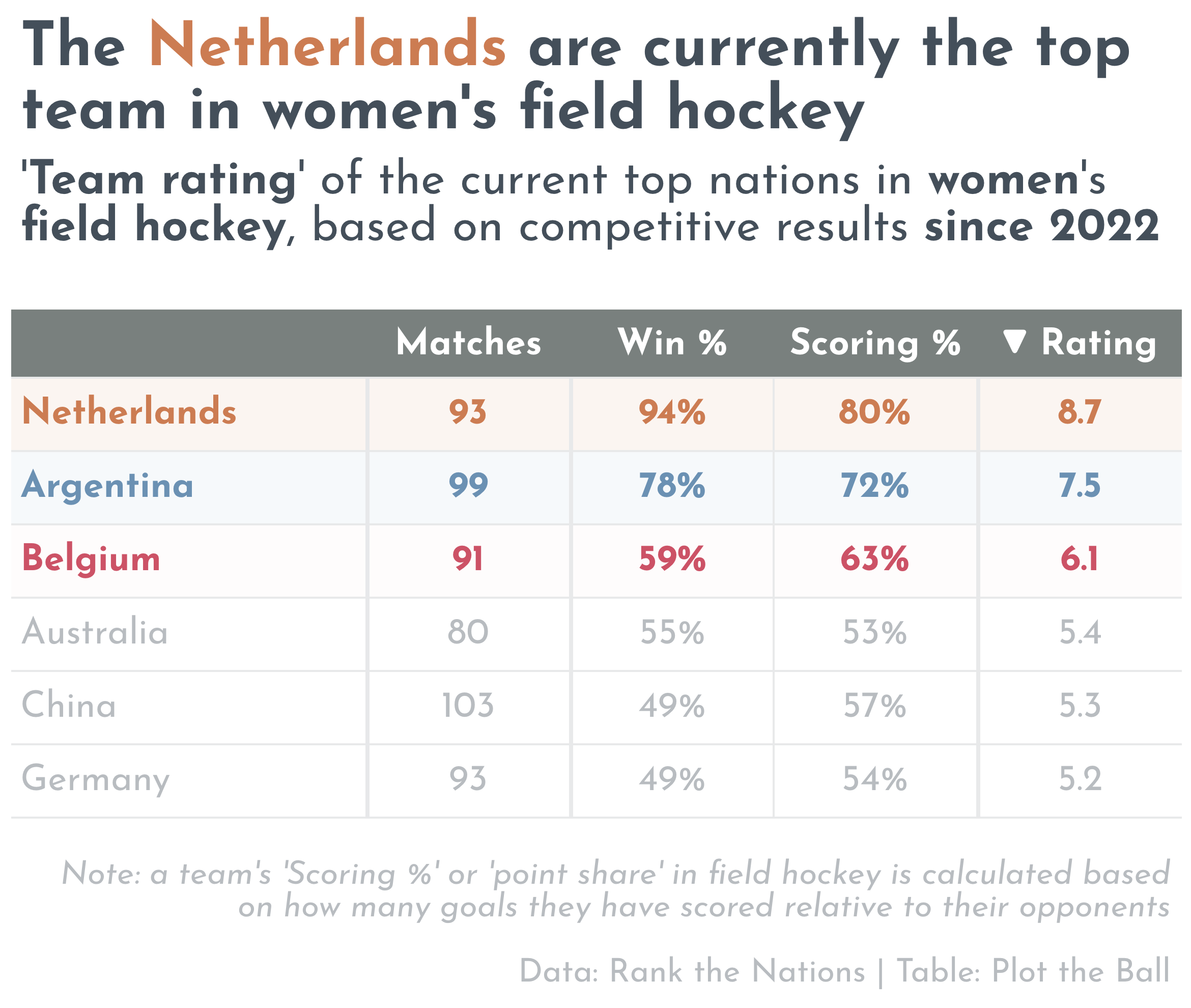
The latest round of 2025-26 Pro League fixtures concluded this week, and the Netherlands are still unbeaten — with a goal difference far beyond their closest challenger. Their competitive record is truly remarkable: they’ve won five out of six possible Pro League titles, the last five EuroHockey Championships, the last three World Cups and the last two Olympic gold medals. They host the 2026 World Cup on home soil in August; anything but another Dutch win would leave me hugely surprised.
🇳🇱 The Netherlands lead the first edition of the men’s field hockey ratings
The Netherlands (7.0) are also the top-rated team in men’s field hockey. While their overall level is well short of their female compatriots, there is still a considerable gap between them and Belgium (6.4) — the next-best team right now.
Overall, ratings in the men’s game are much more compressed. In the women’s, only the six teams in the table above have a rating above 5.0; there are eight such nations on the men’s side, with six of them currently sitting between 5.1 and 6.0.
📊 Chart of the week: Are New Zealand improving in women’s sevens?
Conversely, women’s rugby sevens seems to be moving further away from parity. In recent years, Australia (7.9) have been close behind New Zealand (8.5) at the top; in 2026, the Kiwis have played at a level their nearest challenger can’t match.
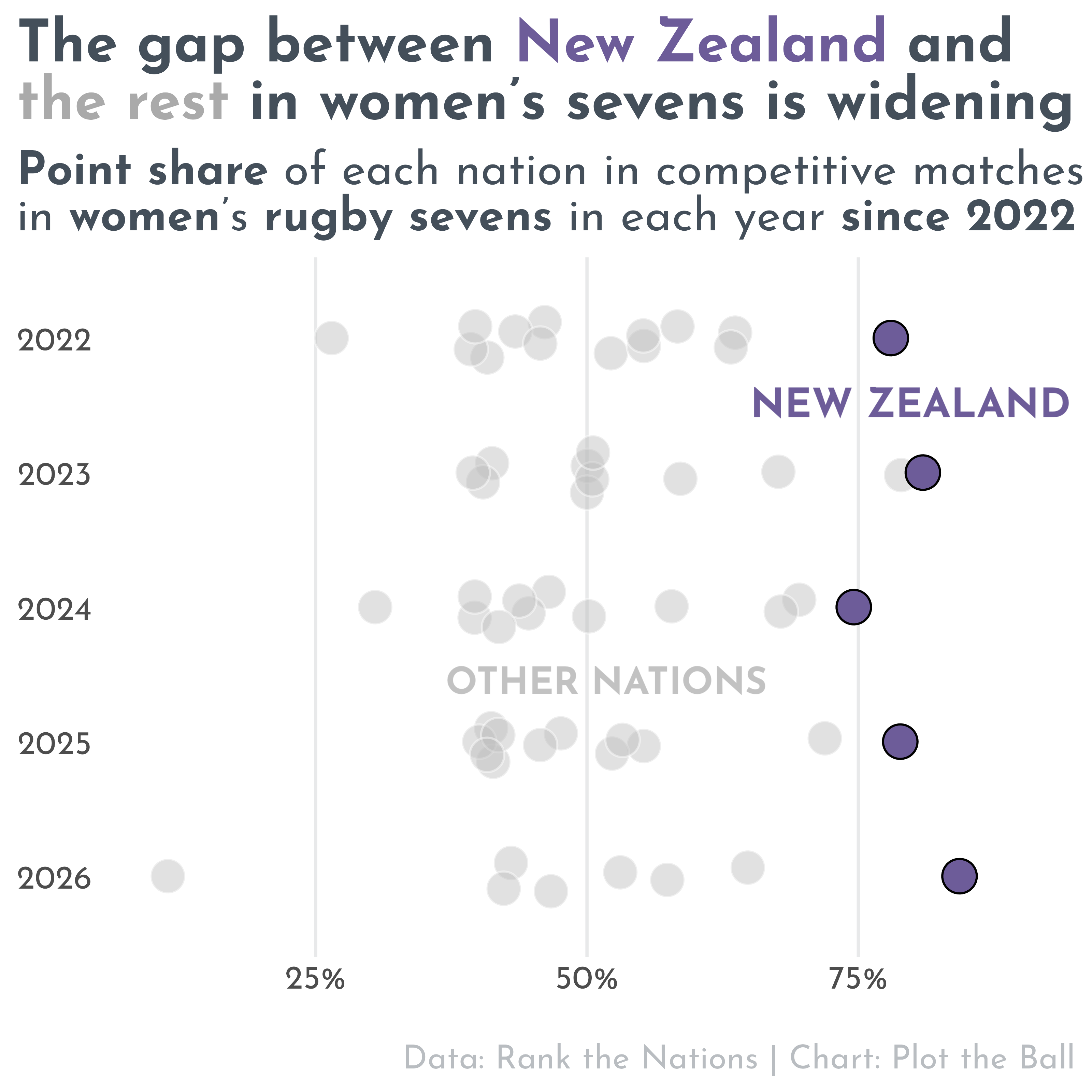
In their games at the two HSBC SVNS Series tournaments held this calendar year, New Zealand have scored 84% of the total points. After a drop-off between 2023 and 2024, they have improved their ‘point share’ by significant increments in both 2025 and 2026. Meanwhile, Australia — who were effectively going point for point with their biggest rivals as recently as 2023 — have dropped well off the pace by this metric: their point share of 65% so far in 2026 would be their lowest mark of this era.
⏪️ Highlight of the week: Sam Kerr’s return for the Matildas
In happier news for Australian sports fans, Matildas superstar Sam Kerr is back in action at the Asian Cup. The continent’s major women’s soccer tournament kicked off yesterday in Perth, and only Japan (7.0) are rated more highly than the hosts (6.2).
Kerr spent well over a year on the sidelines for her club Chelsea after rupturing a knee ligament in January 2024, and her goal in the Asian Cup opener this weekend against the Philippines was her first for Australia in 851 days. It was a very pleasing striker’s goal: as a cross sailed over her head in the six-yard box, Kerr stayed put and let the two defenders around her swarm towards the ball. A headed pass from a teammate sent it back in her direction, and she nodded the ball home from a few yards out.
You can watch a replay of this goal on YouTube here.
💭 What else I learned last week
For The Guardian, Samantha Lewis reported on North Korea’s return to a major international soccer competition — for the first time since 2012 — at the Asian Cup. Despite this long absence at senior level, they have a lot of talent to build a team around: “[t]hanks to their decades-long investment in women’s football, particularly the opening of the Pyongyang International Football School in 2013, the nation’s youth teams are experiencing a second wave of success”.
For MLB.com, Mike Petriello compared the last of the World Baseball Classic in 2023 to the baseball most fans are used to watching in the major leagues. One statistic in particular foreshadowed a change at MLB level: the frequency and effectiveness with which pitchers from Japan threw split-finger fastballs. Per Petriello, their pitchers “threw approximately 62% of all splitters in the tournament themselves; more than half the teams didn’t throw a single one”.
For Good Areas, Jarrod Kimber quantified what makes India’s T20I cricket opener Abhishek Sharma different from other aggressive batters in the format. He scores more quickly in the first 10 balls of his innings than anyone else, and does so by hitting the ball in the air much more frequently than anyone else — while maintaining elite levels of control. As Kimber puts it: “[h]e’s taking more risk than anyone ever has, and being rewarded more than any ever has”.
The next edition of the newsletter will be published on Monday March 9th.
