


This year at Plot the Ball, I’m using data to try and better understand the landscape of international team sport. For some background to this project — which I’m calling ‘Rank the Nations’ — you can read my introductory post here.
In today’s special edition of The Week in International Sport, focused on the ice hockey tournaments at the 2026 Winter Olympic Games:
🇺🇸 The USA winning gold in the women’s tournament
🇺🇸 The USA winning gold in the men’s tournament
📊 Chart of the week: assessing the competitiveness of the women’s ‘final four’
⏪️ Highlight of the week: Mitch Marner’s overtime game-winner
💭 A few other interesting things I learned
As a reminder: the team ratings used in this newsletter are on a zero-to-10 scale, and are calculated based on a nation’s performance in competitive fixtures in a given sport since the start of the 2022 calendar year. (For more detail, click here.)
🇺🇸 The USA win Olympic gold in the women’s ice hockey tournament
Coming into the women’s tournament at this Olympics, I wasn’t sure what to expect. The USA were neck-and-neck with Canada in my ratings; however, I exclude bilateral fixtures from this system to avoid skewing teams’ relative schedule strength too much.
Why is that relevant? Late last year, the Americans comfortably won all four matches in the two teams’ annual ‘Rivalry Series’. In retrospect, this was a strong indicator of their quality: after going undefeated on their way to gold, there’s now no doubt that the USA (8.5) are the world’s strongest women’s ice hockey team. While there was jeopardy in their gold-medal game against Canada (8.0) — it was decided in sudden-death overtime — a win by their neighbours would have been a definite upset.
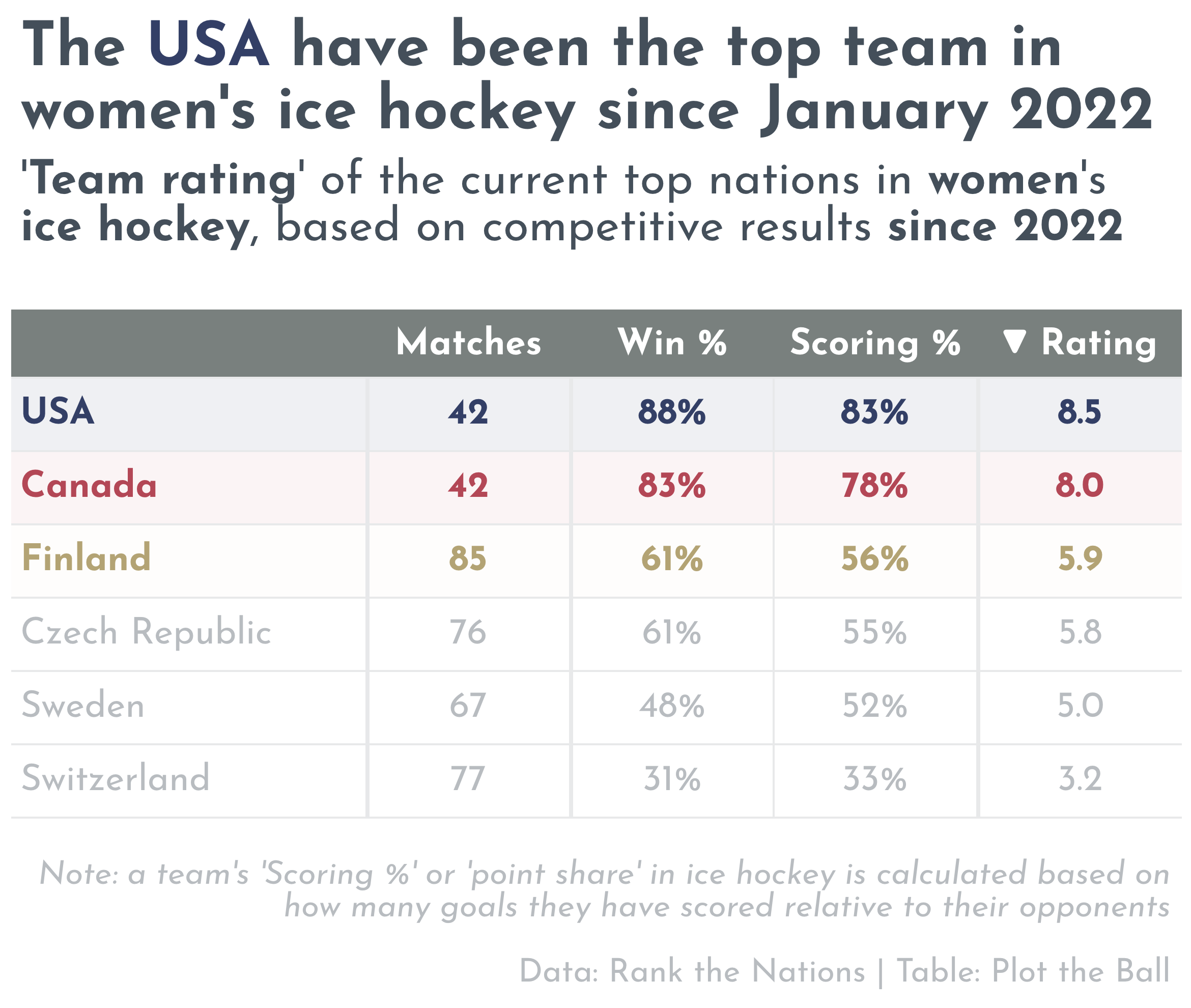
Below the two standout teams at the top, Switzerland (3.2) won bronze after beating Sweden (5.0) in overtime. Currently rated as the sport’s sixth-best team by this system, the Swiss snuck through three low-scoring games in the knockouts by an aggregate of four goals to three. (Two one-goal victories offset a 2-1 loss to Canada in their semi-final.) This marked a real turnaround from their preliminary-stage performance: they lost their first four matches at the Games 5-15 in aggregate.
🇺🇸 The USA win Olympic gold in the men’s ice hockey tournament
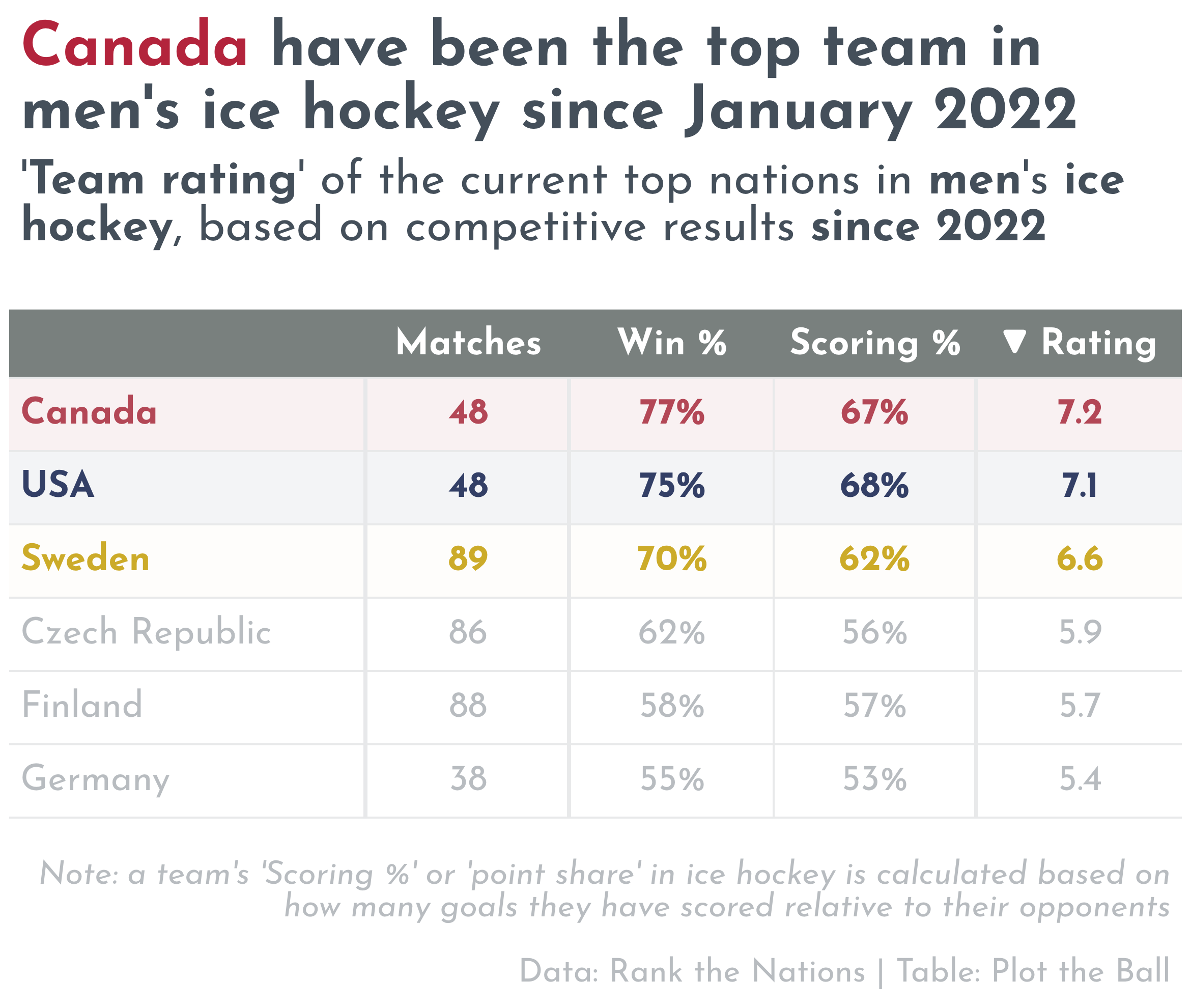
Unlike in the women’s game, the gold-medal-winning team from the USA (7.1) hasn’t been the top-rated team in men’s ice hockey over the last five years. The rankings below have Canada (7.2) as slightly better in competitive fixtures since 2022.
Each North American team is comfortably clear of Sweden (6.6) in third place. However, these ratings include a number of annual tournaments which top NHL players are either unavailable for or opt not to participate in: the IIHF World Championship, and — for European nations only — the Euro Hockey Tour. As well as Canada, both Sweden and Switzerland (5.4) have won a higher percentage of their World Championship games over this period than the USA have.
If we consider only the two ‘best-on-best’ tournaments that have taken place in the last year or so, though, the Americans come out on top. Across this month’s Olympic tournament and last year’s 4 Nations Face-Off, Canada and the USA have each won eight of their 10 games. However, yesterday’s gold medallists have scored 70% of the goals in these games; despite their strength with the puck — scoring 4.1 goals per game to the USA’s 3.8 — silver medallists Canada sit at a ‘goal share’ of just 66%.
📊 Chart of the week: How tight were games in the women’s ‘final four’?
It’s too early to assess the impact of the PWHL on international ice hockey; this was the first Games since it was set up in North America in 2023. For now, all we can say is that the ‘final four’ of the 2026 edition was the closest the Olympics has ever seen.
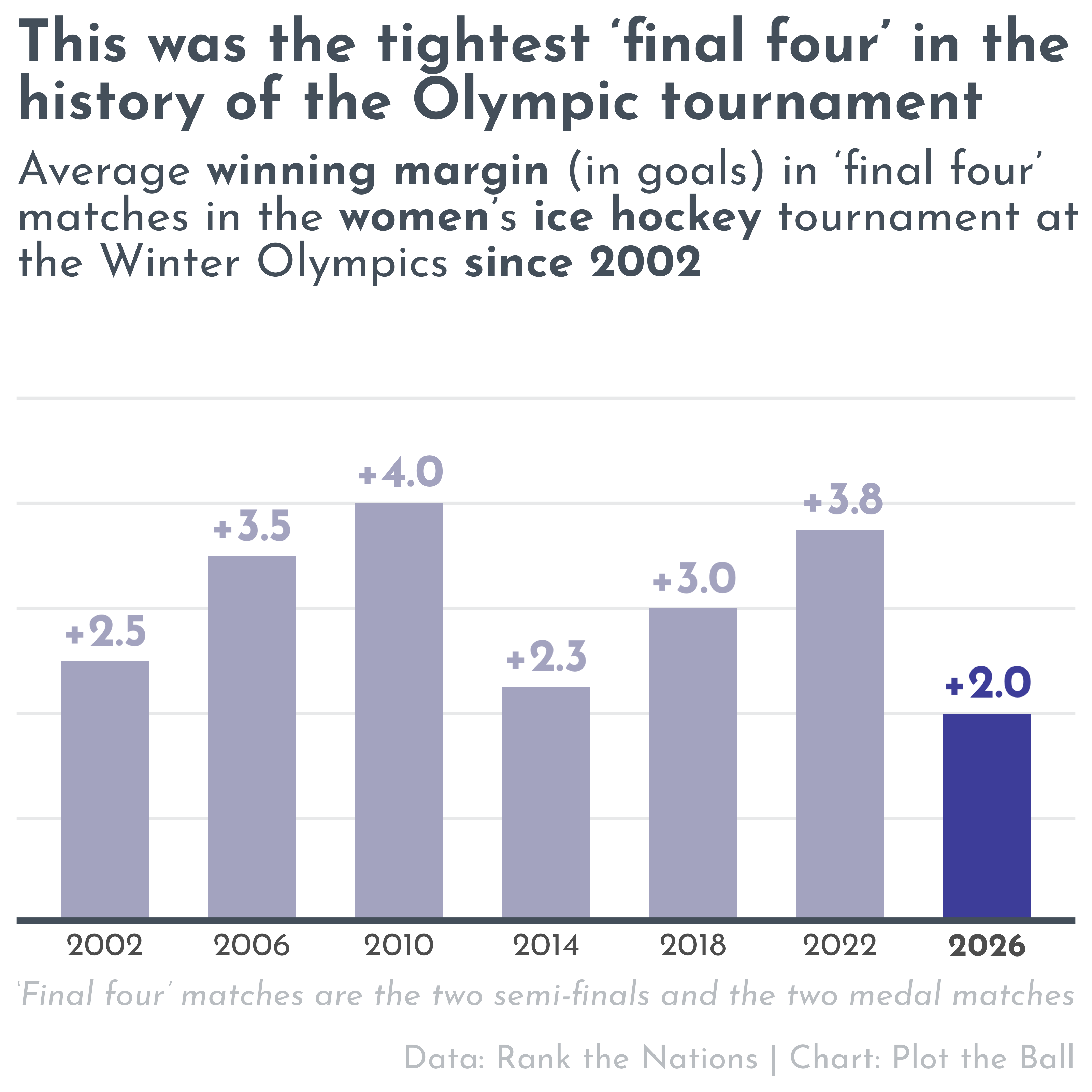
Across the two semi-finals and the two medal matches this year, the average winning margin was just two goals per game — despite the dominant USA team winning their semi-final against Sweden 5-0. This is lower than the average margin at this stage of each of the six previous editions that were decided in this format. (There were no semi-finals in the first edition in 1998.) The drop from four years ago was notable: in 2022, ‘final four’ games were decided by a margin of almost four goals on average.
⏪️ Highlight of the week: Mitch Marner’s overtime game-winner
It’s no secret to long-time readers that I have a lot of contempt for ‘psychobabble’. With that in mind, I enjoyed seeing several players who often cop flak at NHL level putting in performances during the men’s tournament that challenged such narratives.
Goalie Connor Hellebuyck — who apparently can’t handle the pressure of the NHL playoffs — pulled off some incredible saves to keep the USA in the gold-medal game. On Canada’s side, Mitch Marner has faced similar criticisms in the postseason. His team didn’t end the Games how they wanted, but Marner came good in a high-stakes moment: during overtime in their quarter-final, the forward scythed through the defence and flipped a backhand into the net to win the game almost single-handedly.
You can watch a replay of this goal on Bluesky here.
💭 What else I learned last week
For ESPN, Ryan S. Clark profiled 22-year-old Laila Edwards — one of a number of college athletes on the USA’s women’s team at this Olympics, and the first Black woman ever to represent her country in ice hockey.
For theScore, Kyle Cushman laid out where Canada could go from here to try and put their women’s program back on top of the world. A first step: giving more chances to their own young talent, like 19-year-old Chloe Primerano.
For the Boston Globe, Katie McInerney looked ahead to the resumption of the third season of the PWHL this week. USA forward Kendall Coyne Schofield told McInerney: “women’s hockey isn’t going to go silent, it’s not going to go dark”.
For The Athletic, James Mirtle examined how few NHL games goalies from Canada are playing. Their share of the league-wide total “has dipped from 65% at the turn of the millennium down to an all-time low of 24.9% this season.”
For the Hockey PDOcast, Dimitri Filipovic tracked some key statistics during the men’s tournament. One finding: Canada’s reliance on their ‘big three’ — Connor McDavid, Nathan MacKinnon and Macklin Celebrini — to create chances.
For The Athletic, Pierre LeBrun and Dom Luszczyszyn tried to work out how strong Russia’s men’s squad would have been, had they been free to compete. Their best guess: “[a] team that would’ve likely been the bronze medal favorite”.
The next edition of the newsletter will be published on Monday March 2nd.
