

🌍 The Week in International Sport
Monday February 9th: women's water polo, U19 cricket and Kaltounková's Olympic opener

This year at Plot the Ball, I’m using data to try and better understand the landscape of international team sport. For some background to this project — which I’m calling ‘Rank the Nations’ — you can read my introductory post here.
In today’s edition of The Week in International Sport:
🇳🇱 The Netherlands winning a European title in women’s water polo
🇪🇸 Spain winning a European title in men’s futsal
📊 Chart of the week: assessing India’s success in youth ODI cricket
⏪️ Highlight of the week: Kristýna Kaltounková’s first Olympic point
💭 A few other interesting things I learned
As a reminder: the team ratings used in this newsletter are on a zero-to-10 scale, and are calculated based on a nation’s performance in competitive fixtures in a given sport since the start of the 2022 calendar year. (For more detail, click here.)
🇳🇱 The Netherlands win the 2026 Women’s European Water Polo Championship
Already, this project has been useful for highlighting sports where playing talent in the men’s game appears to be differently distributed to the women’s version. (Why these differences arise is another question, which I’ll try and answer as the year goes on.)
Water polo is one sport that it’s helpful to look at through this lens. Like in the men’s game, Spain (7.3) have been the top-rated women’s side since 2022; however, only two other nations from the men’s top six are also present at the top of the women’s rankings. There is much more geographical diversity on the other side of the sport: whereas the men’s top six featured only European nations, two countries from other continents — the USA (7.2) and Australia (6.0) — feature in the table below.
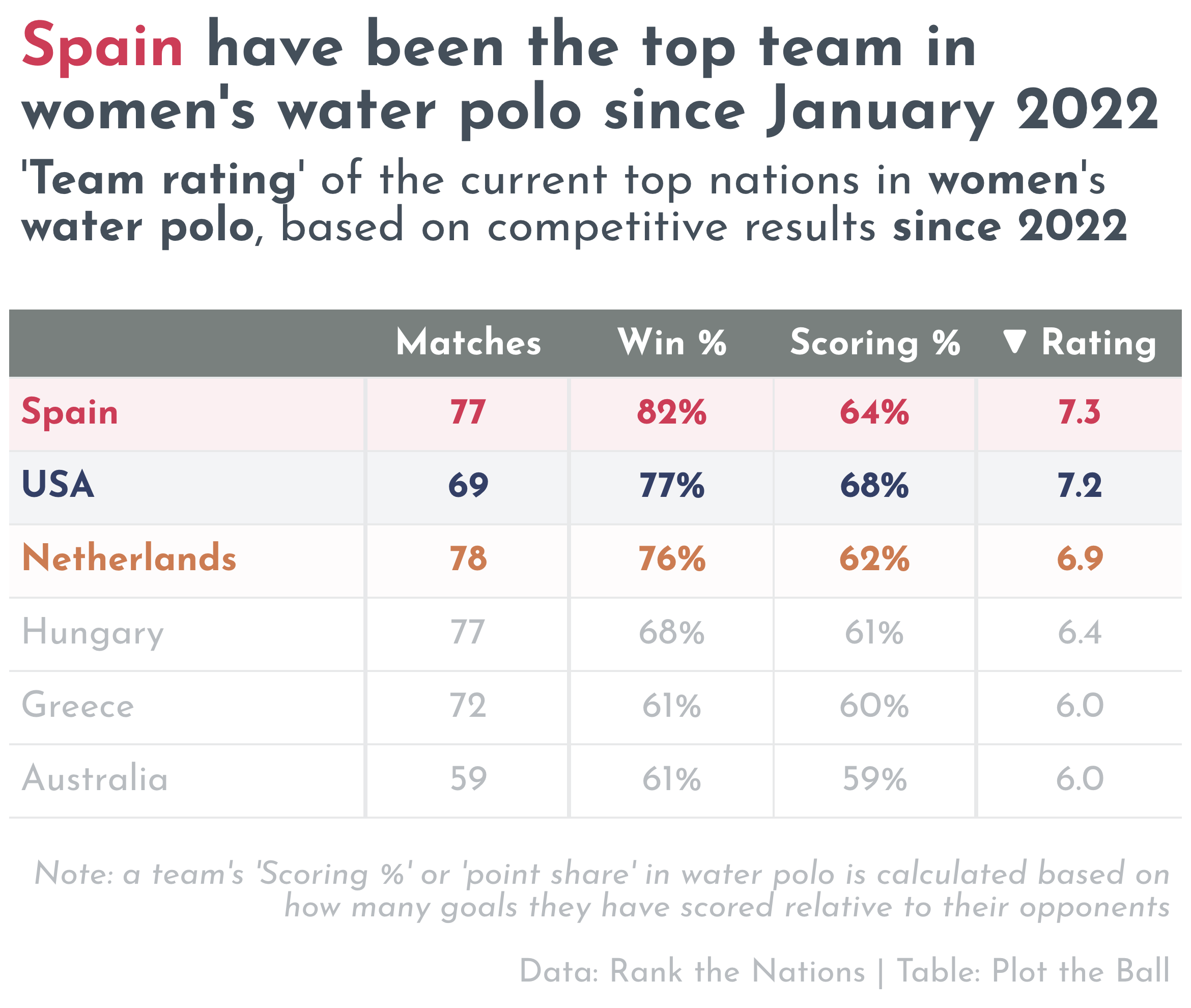
They’re not shown here, but Canada (5.5), Brazil (4.3) and New Zealand (3.8) also round out the women’s game’s top 10. (Only two non-European nations makes it into the men’s top 10.) I’m keen to learn more about water polo in the Netherlands, too. They have one of the highest-rated women’s teams in the world (6.9), and won a second consecutive European title last Thursday. Their men’s team, in contrast, hasn’t even played enough top-level games over the last five years to qualify for a rating.
🇪🇸 Spain win the 2026 men’s European Futsal Championship
For the second weekend in a row, two of the top nations in men’s futsal went head to head in a continental final. While the favourite won last week’s Copa América decider, the last game at UEFA Futsal Euro 2026 was won by the lower-rated team.
On Saturday, Spain (7.5) beat Portugal (7.9) 5-3 to win their first European title in a decade. Both teams were unbeaten heading into the final; in fact, Portugal hadn’t lost at the Euros since 2016 — when Spain knocked them out on the way to their last title.
📊 Chart of the week: Are India unstoppable in youth ODI cricket?
As well as cross-gender comparisons, I’m also interested in using this database to compare nations’ performances across age-grades. With the conclusion of the men’s under-19 World Cup last week, I thought ODI cricket was a good place to start.
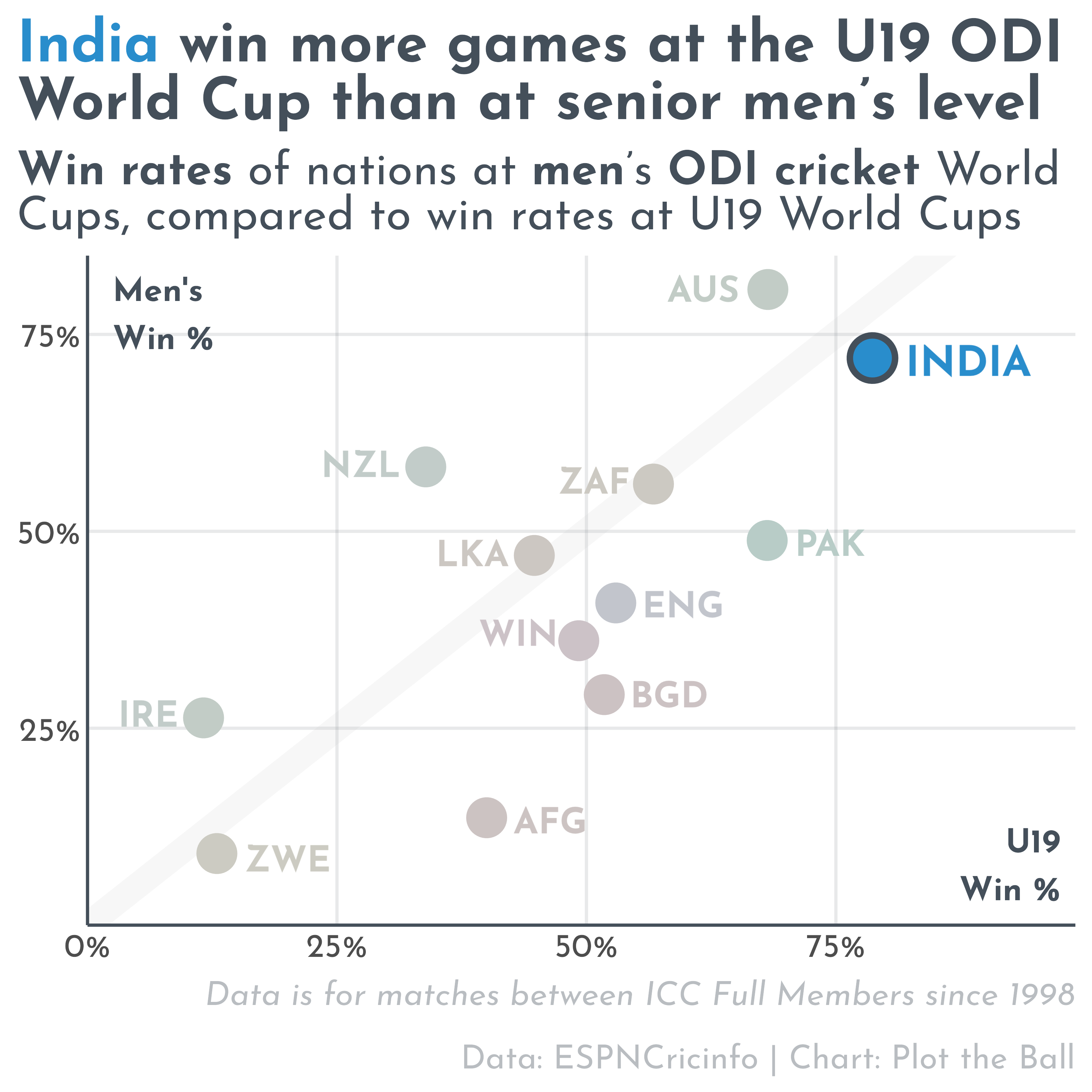
Here, I’ve compared each nation’s win rate in U19 World Cup matches to their win rate in senior men’s World Cups since 1998. India and Australia are the top two at each level, but the much larger country does much better at U19 level. This lines up with my expectation: bigger populations should churn out more talent on a year-to-year basis, but a bottleneck effect exists at the top of international sport. It doesn’t matter if you have 50 cricketers of international quality; only 11 can play at any one time.
⏪️ Highlight of the week: Kristýna Kaltounková’s first Olympic point
Europeans aren’t just moving to North America to play professional women’s ice hockey, as we saw last week; many emigrate to play at collegiate level, too. One such player is Kristýna Kaltounková, a 23-year-old forward from the Czech Republic.
Kaltounková was the first selection in last year’s PWHL Draft out of Colgate University, and has already established herself at senior level: she was an All-Star at last year’s World Championship, and — per The Athletic’s player-value model, at least — is the best player at this year’s Olympics not on the roster of the USA or Canada. She got her first point at the Games on Friday by putting her body on the line, throwing herself towards a rebound and spearing the puck between the Swiss goalie’s legs into the net.
You can watch a replay of this goal on Instagram here.
💭 What else I learned last week
For The Athletic, Dom Luszczyszyn analysed the strength of every elite nation’s men’s ice hockey team at past major tournaments. One interesting takeaway from this work is that — despite their squad’s enviable depth this year — Sweden’s best players at this Olympics don’t match up to their stars of the past. Per Luszczyszyn: “Sweden’s top four forwards and top defenseman usually combine for 70 goals of value. The 2026 roster sits at 55.”
For The Ringer, Ben Lindbergh looked back over the history of the rosters picked by the USA for the World Baseball Classic. This year, things look particularly good for the country that will host the WBC’s knockout rounds — especially on the pitching mound, where the Americans have generally failed to persuade top eligible players to join their team. Lindbergh concludes that this is “the first time that an American club in the WBC can truly aspire to a “Dream Team” label”.
For The Athletic, Colin Millar and Felipe Cárdenas reported on measures brought in by Argentina’s national governing body to prevent soccer players who sign their first professional contracts overseas from being called up for international squads. This initiative is designed to keep their best youth players on home soil; “[s]even players who have been called up to the [men’s] senior squad since the September international window would not qualify for selection under this rule”.
The next edition of the newsletter will be published in two weeks’ time, on Monday February 23rd.
