


This year at Plot the Ball, I’m using data to try and better understand the landscape of international team sport. For some background to this project — which I’m calling ‘Rank the Nations’ — you can read my introductory post here.
In today’s edition of The Week in International Sport:
🇦🇺 Australia winning a world title in women’s T20I cricket
📊 Chart of the week: assessing India away from home in ODI and T20I cricket
⏪️ Highlight of the week: Mario Hezonja’s fast hands
💭 A few other interesting things I learned
As a reminder: the team ratings used in this newsletter are on a zero-to-10 scale, and are calculated based on a nation’s performance in competitive fixtures in a given sport since the start of the 2022 calendar year. (For more detail, click here.)
🇦🇺 Australia win the 2026 Women’s T20 World Cup
Australia’s spell without a world title didn’t last long: in the T20I cricket World Cup final at Lord’s yesterday, they comfortably beat hosts England to cap off an unbeaten seven-game run through the tournament.
England (6.8) had also won six from six ahead of the decider, but were granted a marginally easier path through the pool stage — even leaving home advantage aside. Australia (7.6) had to beat South Africa (5.6) and India (5.5) — the third- and fifth-ranked teams below — to qualify from their group, while the hosts overcame fourth-ranked New Zealand (5.6) and sixth-ranked West Indies (5.2). (According to my rating system, the two weakest teams at the World Cup — Scotland (2.8) and Ireland (2.8) — were also in England’s pool.)
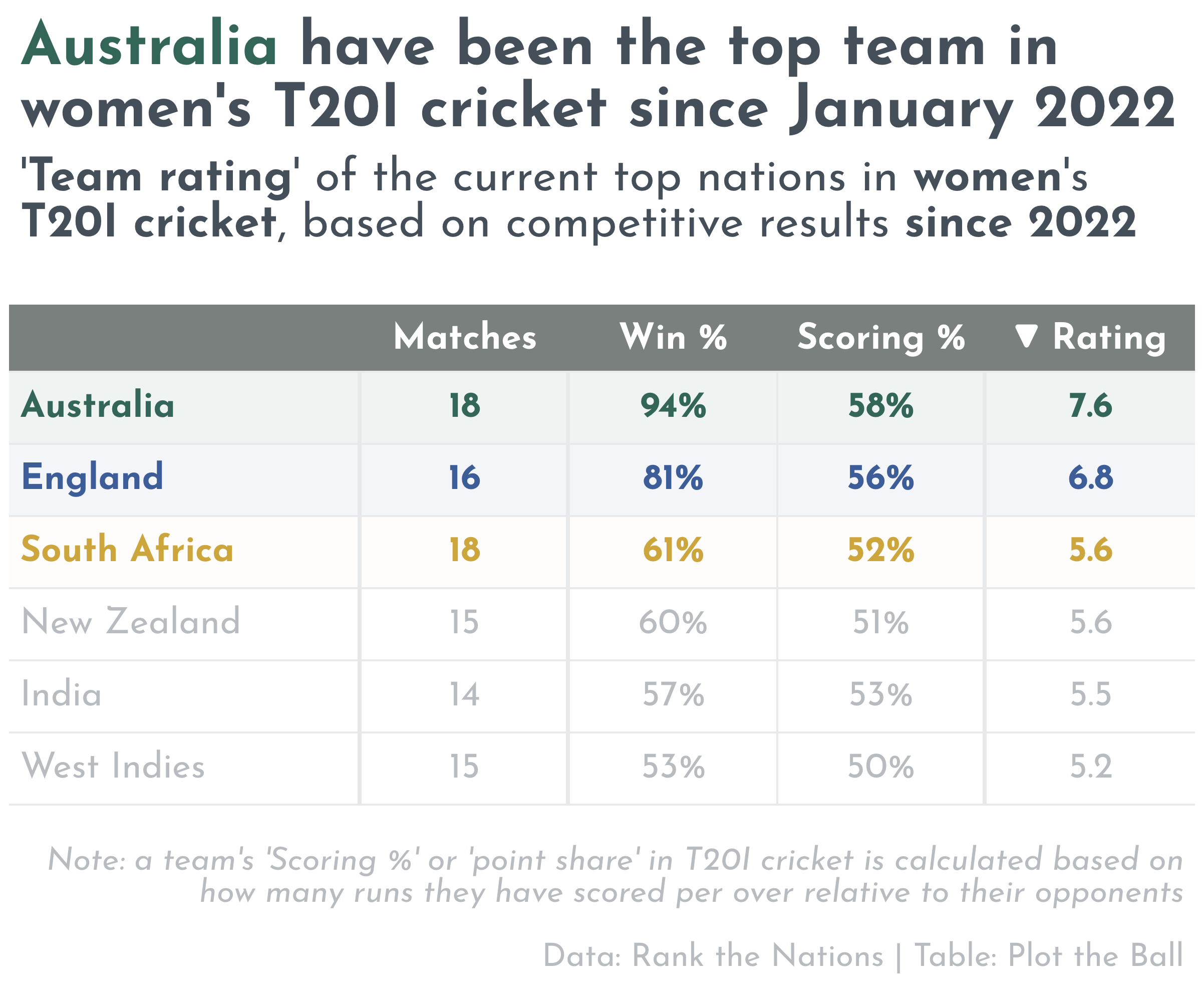
Most remarkable about the performance of the eventual winners was the even spread of contributions they got from their many stars. Cricinfo — the sport’s publication of record — calculated a context-adjusted ‘impact’ score for every player in every match at this World Cup. On a per-game basis, the three highest-rated Australians — Ashleigh Gardner, Ellyse Perry and Phoebe Litchfield — sat in 21st, 22nd and 23rd place in the website’s ‘most valuable player’ rankings at the end of the tournament.
📊 Chart of the week: Do India’s cricket teams struggle away from home?
India have had plenty of good days in white-ball cricket in recent years. Last Sunday — when the men’s team lost a T20I series to Ireland for the first time, and the women were knocked out of the T20I World Cup in England — was one of the bad ones.
How much did these poor results have to do with exposure to unfamiliar conditions in a different part of the cricketing world? That specific question isn’t easy to answer. However, we can easily check whether Indian teams have performed better in general in competitive white-ball matches held closer to home. (For this analysis, I’ve grouped together all T20I and ODI tournaments organised by the ICC and hosted by India, Sri Lanka, Pakistan or Bangladesh so far in the 21st century.)
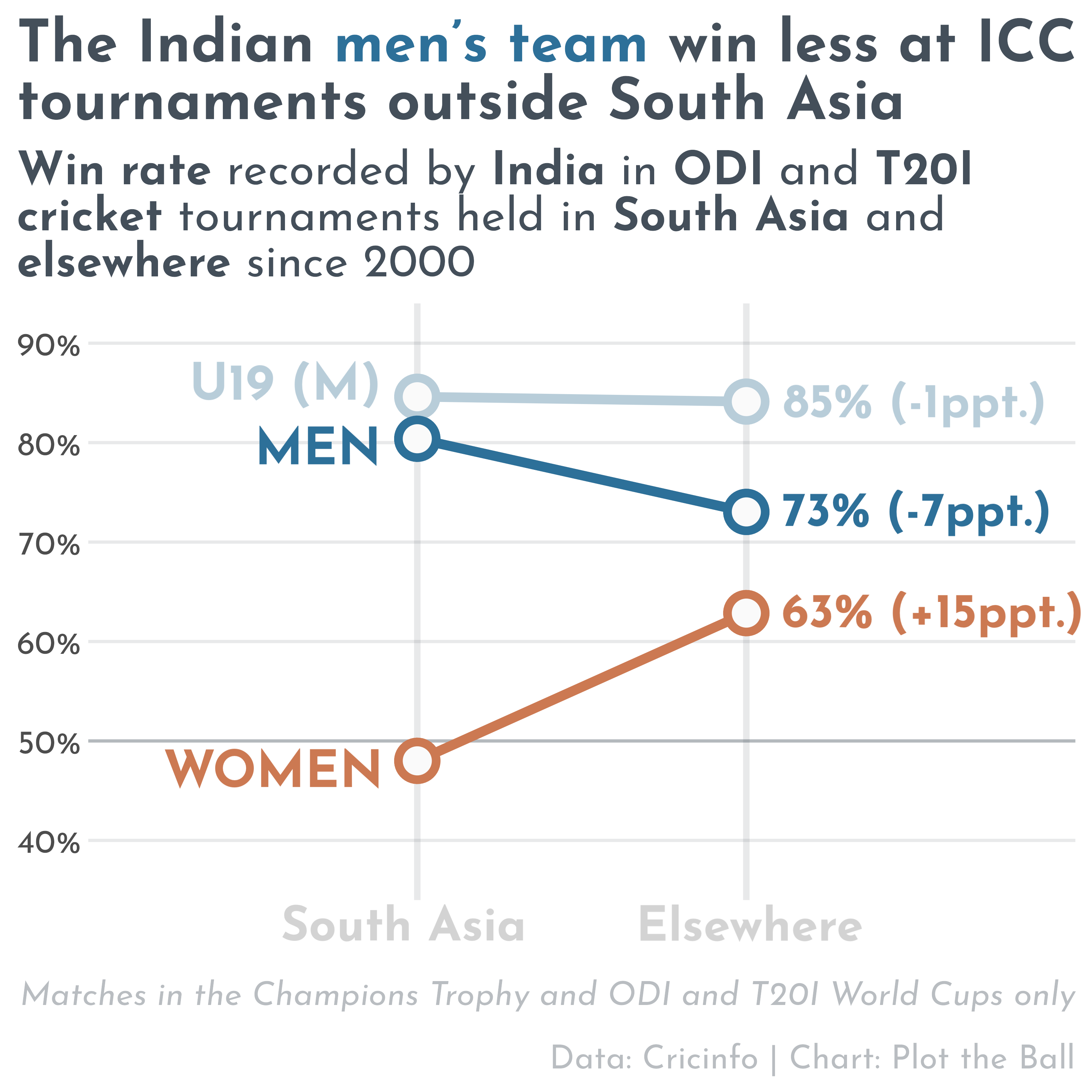
A couple of poor showings at tournaments they hosted mean that India’s women actually have a worse record in their home region than they do elsewhere. The men’s team, however, does seem to struggle a bit: their white-ball win rate drops from 80% in South Asia to 73% in other countries. It’s particularly interesting to note — given the upset on Irish soil — that their level drops most significantly in the shorter format. In ODIs, their win rate falls by about three percentage points; in T20Is, it’s almost 15.
⏪️ Highlight of the week: Mario Hezonja’s fast hands
Really, this section should belong to Lionel Messi. (Or Sidny Lopes Cabral.) If you’re keen on soccer, though, you’ll already be following the FIFA World Cup. Even if you’re a basketball fan, you might not be watching the ongoing FIBA World Cup qualifiers.
Mario Hezonja was a top-five NBA draft pick back in 2015 whose North American career didn’t quite pan out as hoped. The 31-year-old has been back in Europe since 2020, and still represents Croatia internationally. Against weaker opponents — like Cyprus, say, who they beat by 73 points on Friday — his talent still shines through. In one second-quarter sequence, Hezonja showed off his skills by nabbing a steal at one end of the court and whipping a one-handed overarm pass for an assist at the other.
You can watch a replay of this assist on YouTube here.
💭 What else I learned last week
For Expecting Goals, Michael Caley summarised just how impressive Cape Verde were at this year’s men’s soccer World Cup. Argentina needed extra time to beat them in the first knockout round on Friday; they also held Spain to a 0-0 draw in the pool stages. It wasn’t simply a fluke of a low-scoring sport, either: “they put in performances rated just as strong as those of far more famous [footballing] nations like Croatia, Belgium and Uruguay on the underlying numbers”.
For Stuff, Louis Herman-Watt spoke to the parents of Anton Segner, a 24-year-old born in Germany who has just been called up to New Zealand’s national rugby union team for the first time. After interacting with Kiwi coaches at home in Frankfurt, he emigrated at 15 to finish his education there. “[T]here was no chance to stop him,” his father said. “First you think, ‘okay that's a weird idea’, and then you start working on it, and then ‘okay, we understand it's your big dream’.”
For CNBC, Alex Sherman reported on the Premier Lacrosse League’s expansion plans after the competition announced last week that it had raised another $100mn from investors. Its co-founder hopes that the 2028 Olympics in the USA will increase public interest in the league, and they intend to open up franchises to private ownership in the next few years. International teams will play a modified ‘sixes’ format in Los Angeles, while PLL teams play traditional field lacrosse.
The next edition of the newsletter will be published on Monday July 13th.
