

🌍 The Week in International Sport
Monday January 26th: men's water polo, Fiji in rugby sevens and Abhishek Sharma

This year at Plot the Ball, I’m using data to try and better understand the landscape of international team sport. For some background to this project — which I’m calling ‘Rank the Nations’ — you can read my introductory post here.
In today’s edition of The Week in International Sport:
🇷🇸 Serbia winning a European title in men’s water polo
📊 Chart of the week: assessing Fiji’s trajectory in men’s rugby sevens
⏪️ Highlight of the week: Abhishek Sharma’s statement of intent
💭 A few other interesting things I learned
As a reminder: the team ratings used in this newsletter are on a zero-to-10 scale, and are calculated based on a nation’s performance in competitive fixtures in a given sport since the start of the 2022 calendar year. (For more detail, click here.)
🇷🇸 Serbia win the 2026 Men’s European Water Polo Championship
In yesterday’s final of the Men’s European Water Polo Championship were two of the most decorated nations in the competition’s history: Serbia and Hungary. In recent years, though, both have been overshadowed by other continental rivals.
This situation is a good example of these rankings providing a valuable alternative slant on the landscape of a sport. Men’s water polo has typically been dominated by European countries, and the continent’s major tournament has just concluded; however, none of the four top-rated teams according to my ‘Rank the Nations’ model reached the final. In fact, there is daylight between Spain (7.2) and the two teams behind them — Greece (6.6) and Italy (6.6), both losing semi-finalists last week.
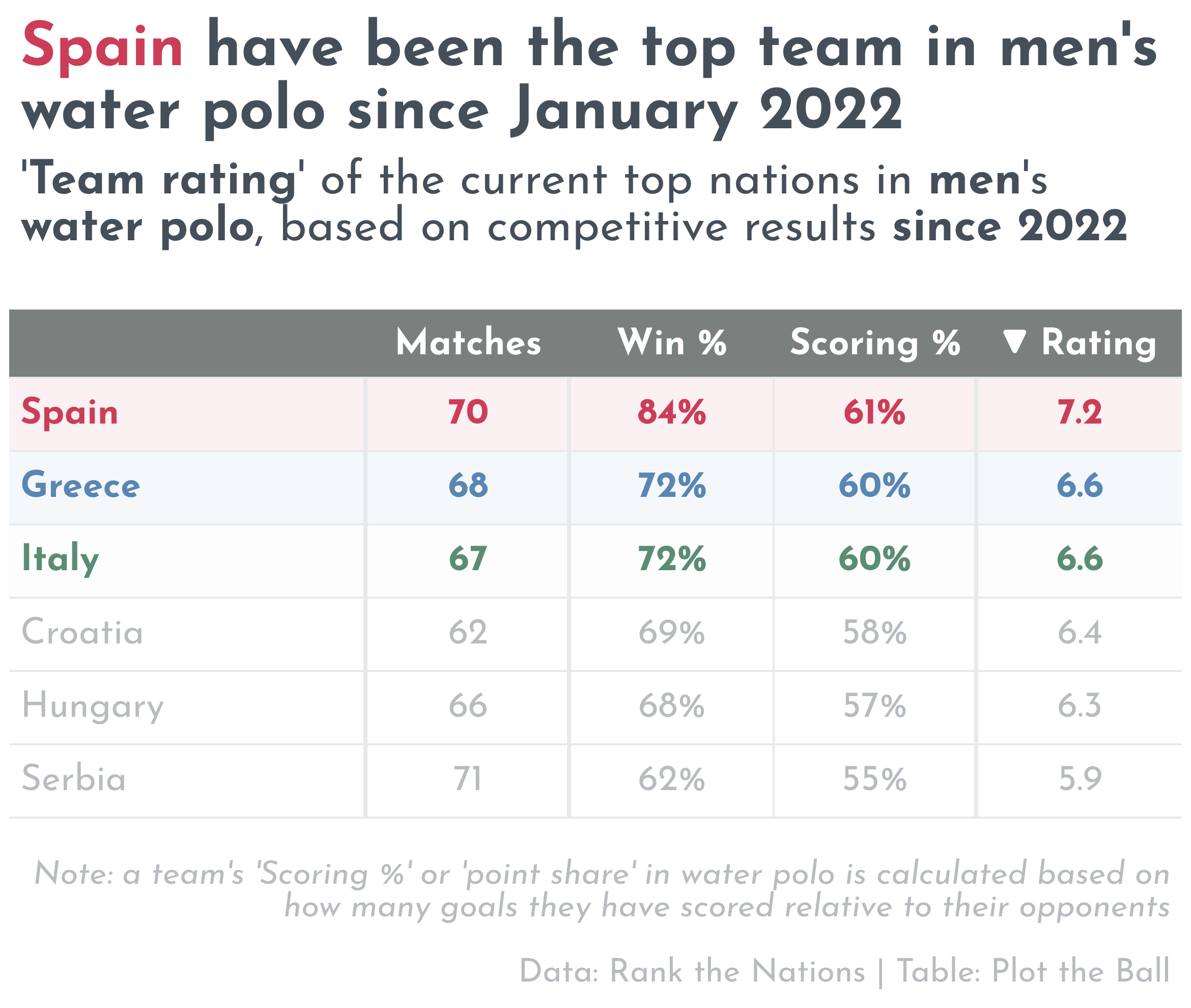
What happened to the defending world and European champions in this tournament? They were drawn in a pool with eventual winners Serbia (5.9) and runners-up Hungary (6.3); all three teams — as well as Montenegro (4.9) — finished that stage with three wins out of five, and Spain had comfortably the best goal difference overall. However, Hungary pipped them in a shootout in their last pool match, and they didn’t qualify for the final four. It seems that water polo is a funny old game, too.
📊 Chart of the week: Are Fiji on a downward trajectory in men’s sevens?
You can’t talk about rugby sevens without talking about Fiji. The Melanesian island nation has won all four of its Olympic medals in the sport that was introduced in 2016: a bronze in the women’s event in Tokyo, to go with two golds and a silver in the men’s.
That silver came in Paris, where they were comprehensively beaten by hosts France. Are they on track to reclaim the top spot in the men’s game in a couple of years’ time? Not if their performances on World Rugby’s sevens circuit are anything to go by: the team has been on a downward trajectory for a number of years. During 2022, they were responsible for 68% of all of the points scored in their competitive matches; this figure fell to around 60% for 2023 and 2024, and further to 56% during 2025.
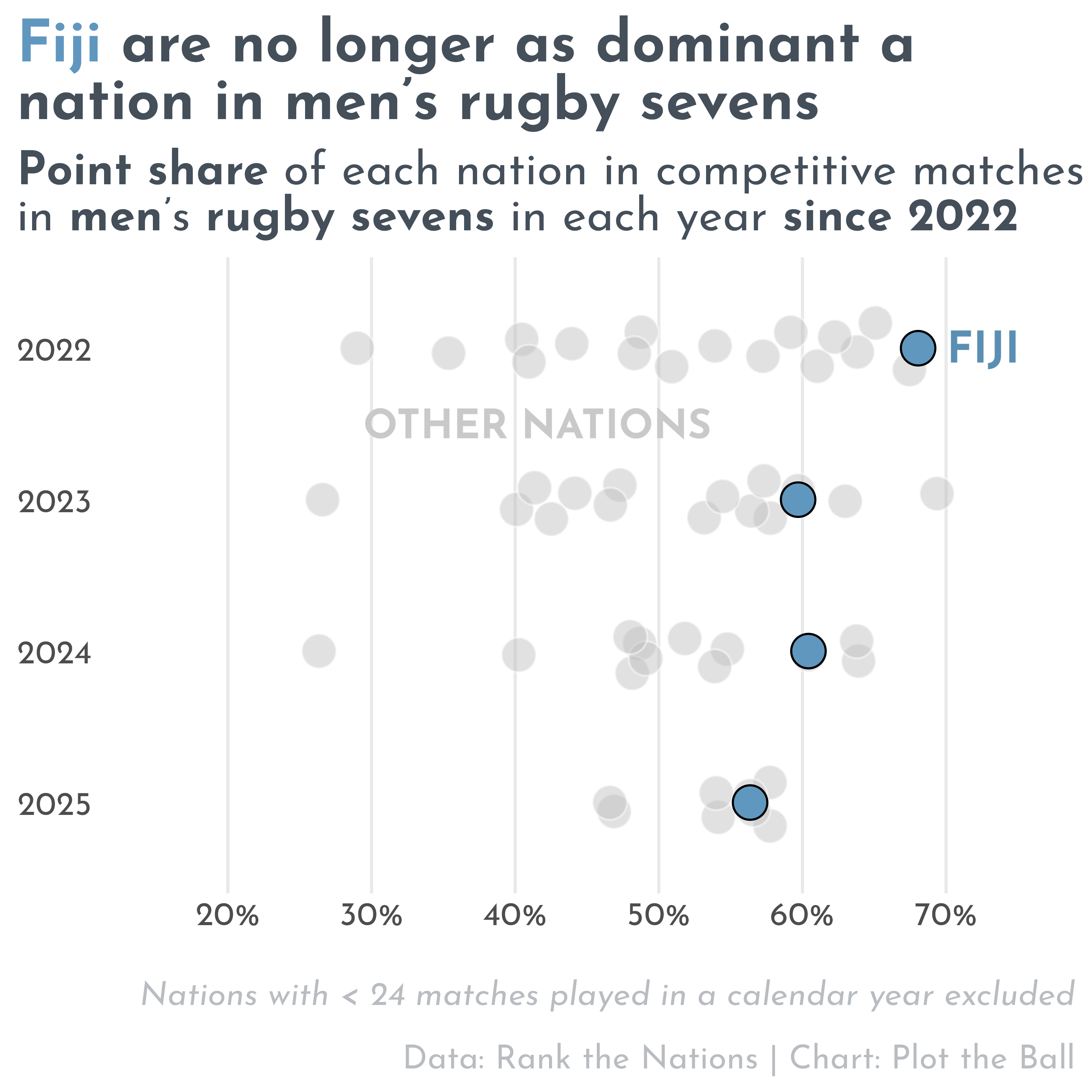
Ahead of this weekend’s event in Singapore, they have the sport’s third-best rating — 6.6, behind New Zealand (6.7) and Argentina (6.8). However, it is worth noting the unusual lack of dispersion in the performance levels of competing nations last year. This hints at how competition structure can influence such a rating system; the annual ‘SVNS’ series was reduced from 12 teams to eight midway through 2025. With fewer matches against weaker opponents, it’s harder for top teams to separate themselves.
⏪️ Highlight of the week: Abhishek Sharma’s statement of intent
As we saw last week, India aren’t currently dominating men’s test cricket. They’ve been exceptionally strong in the two white-ball formats in recent years, though — and Abhishek Sharma is one of the drivers of their remarkable record in T20I cricket.
The ultra-aggressive left-handed batter has featured in 34 matches so far in his international career, and his team have won 29 of them. Abhishek’s commitment to attacking cricket is remarkable. In the second match of their current bilateral series against New Zealand, he was caught on the boundary off the first delivery he faced. In the third match yesterday, he was undeterred. At the very beginning of his innings, the opener advanced down the pitch and launched the ball well beyond the rope.
You can watch a replay of this shot on the BCCI website here.
💭 What else I learned last week
For The Athletic, Chris Weatherspoon broke down Deloitte’s recent report into the finances of some of the top clubs in women’s soccer. As on the men’s side, England is the biggest market in the European game. (Seven of the top 10 clubs by annual revenues come from the WSL.) The drivers of income are different, though. Broadcast deals helped the Premier League surge to the top; “for women’s teams, it is sponsorship deals and partnerships doing the heavy lifting”.
For the Financial Times, Daniel Thomas and Samuel Agini reported on the NFL’s plan to kickstart growth outside the USA. The Head of NFL International told the paper: “Nobody’s interested if you just show up once a year, have a game and then leave”. Flag football — which is set to debut at the Olympics in 2028 — is one key plank, and franchises are encouraged to pursue their own marketing campaigns: “[t]he New York Jets, for example, run a girls’ flag league in the UK”.
At NHL.com, Mike Morreale published a profile of Albert Šmits — an 18-year-old from Latvia who will be the youngest men’s ice hockey player at the Winter Olympics. (He may also become the highest-ever Latvian NHL Draft pick later this year.) With experience in Finland’s top men’s league, Šmits won’t face as much of an adjustment as other teenagers might; Morreale notes that the defender “averages 19:58 of ice time in 33 games with Jukurit this season”.
The next edition of the newsletter will be published on Monday February 2nd.
