

🌍 The Week in International Sport
Monday April 20th: women's handball, England in age-grade rugby and Vivien Endemann

This year at Plot the Ball, I’m using data to try and better understand the landscape of international team sport. For some background to this project — which I’m calling ‘Rank the Nations’ — you can read my introductory post here.
In today’s edition of The Week in International Sport:
🇳🇴 Norway leading the way in women’s handball
📊 Chart of the week: assessing England’s level in age-grade rugby union
⏪️ Highlight of the week: Vivien Endemann’s unusual skill
💭 A few other interesting things I learned
As a reminder: the team ratings used in this newsletter are on a zero-to-10 scale, and are calculated based on a nation’s performance in competitive fixtures in a given sport since the start of the 2022 calendar year. (For more detail, click here.)
🇳🇴 Norway lead the first edition of the women’s handball ratings
When I introduced my first set of rankings for men’s international handball teams a couple of months ago, I wondered how fairly my system rated nations from Europe — the continent that dominates the sport — relative to those from elsewhere.
Are European teams punished by the high level of competition they face in regional tournaments? In the women’s game, the question is immaterial: nations from Europe make up the entire top six of the first set of rankings below. (Brazil (5.5) are the top-ranked team from another continent, sitting seventh; Egypt are in second place in the men’s game.) Two countries from the men’s top three — France (7.0) and Denmark (6.6) — are also present in the women’s, but both trail Norway (7.5) by a distance.
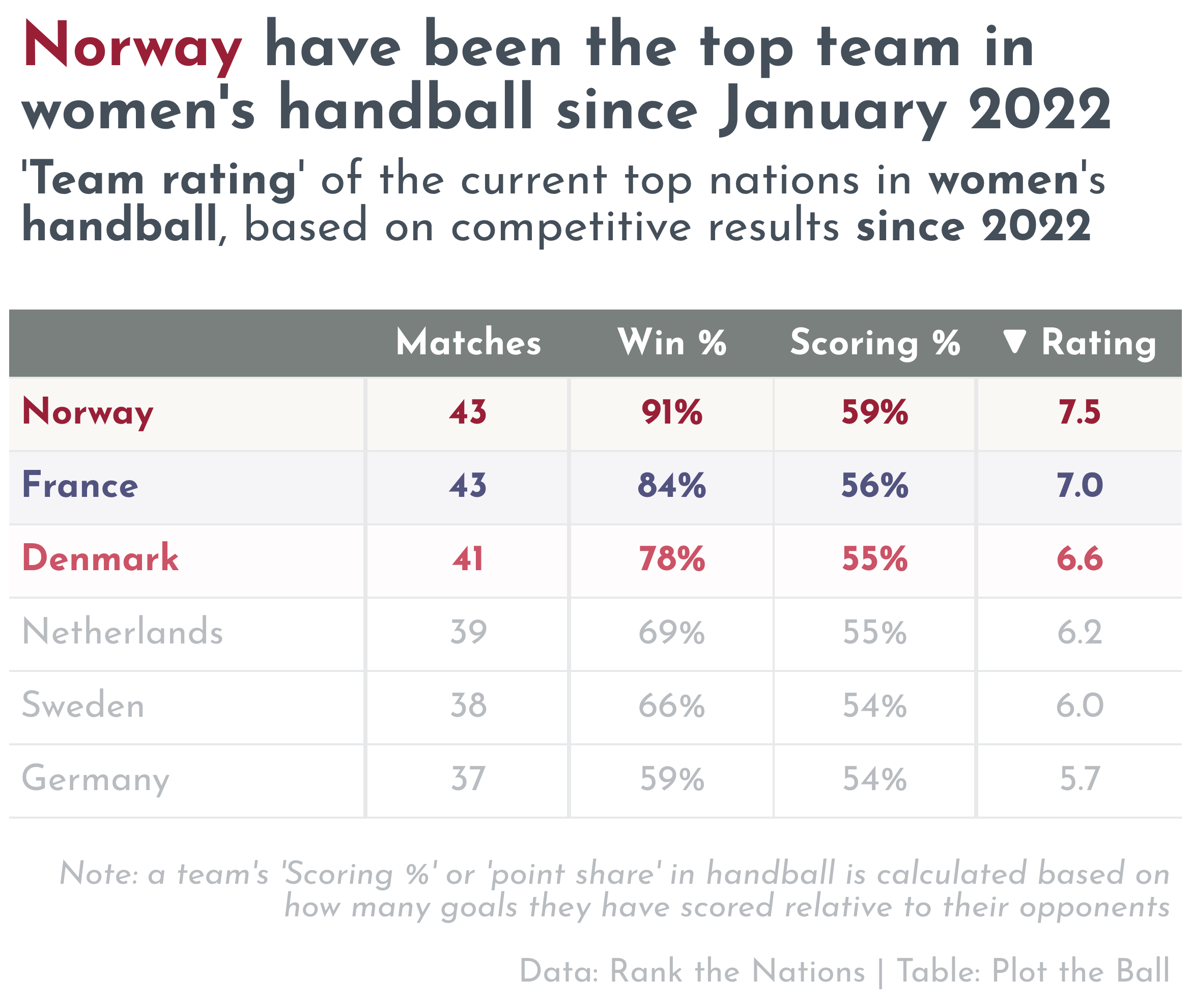
EHF Euro 2026 will be played in December, and the draw has just taken place after the conclusion of the second qualifying phase. Neither Norway nor Denmark featured, having finished in the top three of the 2024 edition; Hungary (5.4) were the other nation to get an automatic berth. Each of the top-six teams above who were required to take part went unbeaten in their qualifiers — but so too did Spain (4.2), whose best finish at a European Championship over the last decade is ninth.
📊 Chart of the week: Why don’t England dominate age-grade rugby?
England took care of Scotland in women’s rugby union on Saturday: they won their Six Nations match 84-7, and an earlier contest at the U21 age-grade by 51 points to 12. Would you expect anything else from the sport’s dominant force?
Actually, the picture is a bit more complicated than that. Since 2024, there’s been a formal structure in place for matches at various age-grades between the traditional ‘Six Nations’. Over that period, England have been miles ahead of every other country at senior level: they’ve scored 83% of the points in their matches in the elite competition. Their performances at U18, U20 and U21 level have lagged far behind, though: in roughly 14 games’ worth of action, they’ve scored just 45% of the points.
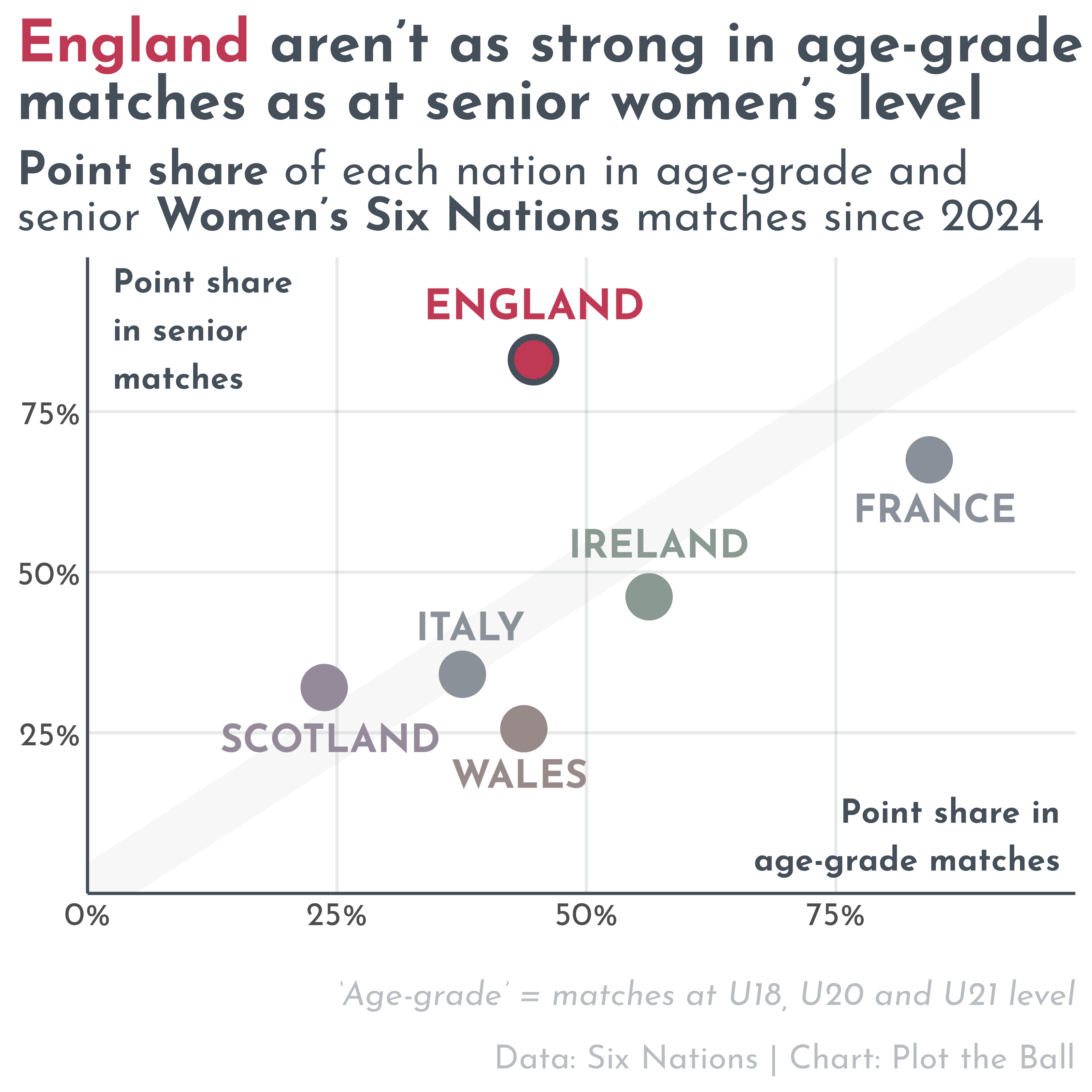
It’s France — the second-best team at senior level over this stretch — who dominate underage women’s rugby union in Europe. (Their aggregate point share at U18, U20 and U21 level is 84%.) What can we take away from this? My read is that England’s dominance of the sport at senior level is not because of a pipeline from the grassroots game bursting with talent; rather, this analysis suggests that their professional system adds a lot of value as players progress up to and through the senior ranks.
⏪️ Highlight of the week: Vivien Endemann’s unusual skill
Opta’s soccer data uses the great descriptor ‘other body parts’ for shots at goal which do not directly come off either foot or a player’s head. To me, it conjures a mental image of a ball bundled messily across the line — not put away with control.
At first glance, you wouldn’t think that Vivien Endemann’s goal for Germany in their recent World Cup qualifier against Austria should fall into this category, such was the poise with which the 24-year-old redirected a cross from the right into the back of the net. On closer inspection, though, it was one of the most skilful finishes off the shin I can remember seeing: meeting the ball on the full, Endemann sent it towards the bottom corner as smoothly as if she was completing a pass with the side of her foot.
You can watch a replay of this goal on YouTube here.
💭 What else I learned last week
For the Financial Times, Chris Kay spoke to the chair of the Indian Premier League about its relationship to men’s test, ODI and T20I cricket. The most financially lucrative of the sport’s franchise tournaments is angling to be given more room in its calendar to expand — at the expense of traditional international fixtures. In their vision of the future, there are “fewer bilaterals, more league cricket, and in between you have [International Cricket Council] events, a bit like [soccer]”.
For The Athletic, Tim Graham continued to cover the professional American football players who hope to play flag football for the USA at the Olympics next year by examining the injury risk associated with changing formats. A former NFL strength and conditioning coach explained: “These are unorthodox movements that aren’t being trained…When you’re not training on a day-in-day-out basis on certain, specific types of movements, you’re always going to be at a higher risk”.
For Stuff, Merryn Anderson interviewed Grace Kukutai, a rugby league player from New Zealand, after she briefly returned to top-level netball. Kukutai — who has also played elite rugby union and rugby sevens — was granted permission by her NRLW coach to play one ANZ Premiership match for her old team as injury cover. She came through unscathed: “I don’t want to let fear hold me back from doing cool stuff…I’m glad my body was prepared enough that I handled it well.”
The next edition of the newsletter will be published on Monday April 27th.
