

🌍 The Week in International Sport
Monday June 15th: women's softball, volleyball delays and Nahid Rana

This year at Plot the Ball, I’m using data to try and better understand the landscape of international team sport. For some background to this project — which I’m calling ‘Rank the Nations’ — you can read my introductory post here.
In today’s edition of The Week in International Sport:
🇺🇸 The USA leading the way in women’s softball
📊 Chart of the week: assessing ball-in-play trends in international volleyball
⏪️ Highlight of the week: Nahid Rana’s high heat
💭 A few other interesting things I learned
As a reminder: the team ratings used in this newsletter are on a zero-to-10 scale, and are calculated based on a nation’s performance in competitive fixtures in a given sport since the start of the 2022 calendar year. (For more detail, click here.)
🇺🇸 The USA lead the first edition of the women’s softball rankings
The distributed World Cup format — where a number of nations host pool-stage games several months before knockouts take place — is more common than I realised before I started following international sport more systematically for this newsletter.
That’s why — in this edition — I’m able to a write a sentence like ‘the 2027 Women’s Softball World Cup starts this week’ and not expect emails of correction in response. Group A matches in the latest edition of the global tournament begin in the Czech Republic tomorrow; Group B — hosted by Peru, but headlined by reigning champions Japan — will take place next month, and Group C is scheduled for September in the USA. The Americans currently top my ratings, but not the official WBSC rankings.
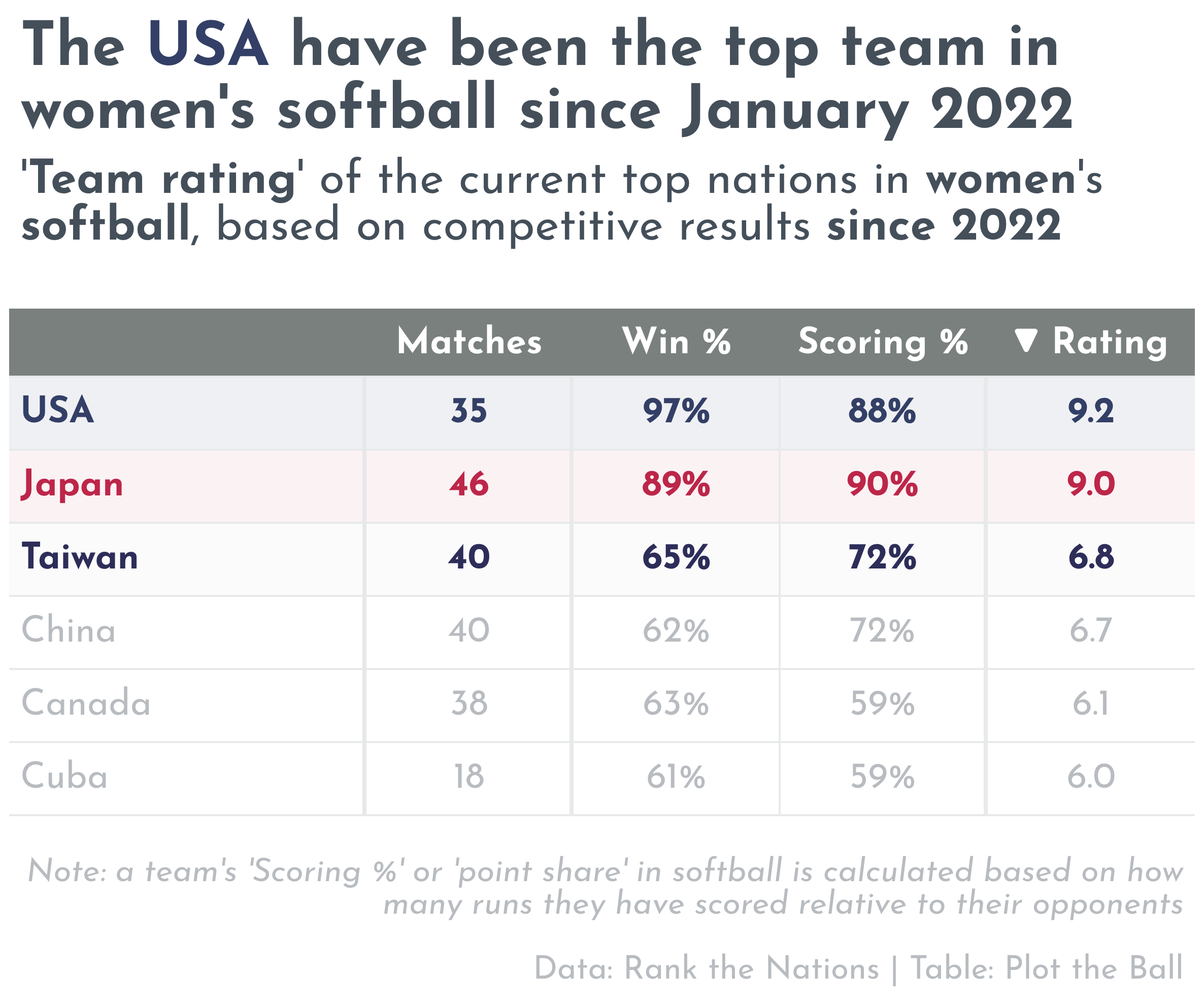
When we do eventually get to the knockout stages, don’t be surprised if it comes down to an elimination game between the USA (9.2) and Japan (9.0). While the Americans lost the last World Cup final to their rivals, they’ve had a slight advantage at the World Games: they won both the gold-medal game in 2022 and their semi-final in 2025 by a single run. Taiwan (6.8) — competing in Group A — are another team to watch: they have four top-three finishes at major tournaments in the last five years.
📊 Chart of the week: Does volleyball have its own ball-in-play crisis?
I think it’s fair to say that ‘ball-in-play time’ is a concept that’s garnering more media attention than it used to — not just in Premier League soccer, where conversation on the topic really took off this season, but in many team ball sports.
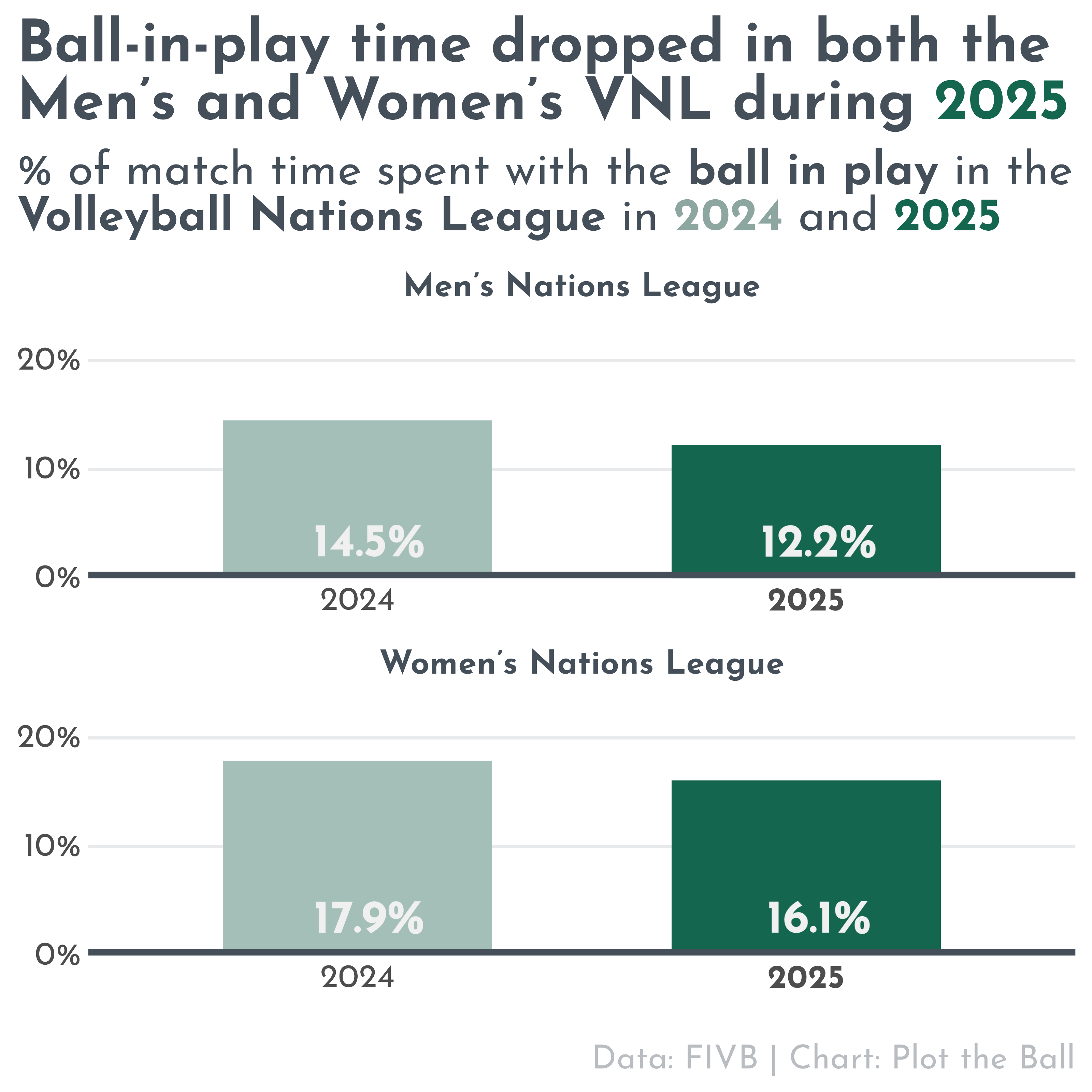
Even a game of discrete events like volleyball is having its own version of this ‘crisis’. In both of last year’s Nations League competitions, the percentage of match time that the ball spent in play decreased, according to the most recent edition of the global governing body’s annual technical report. On the men’s side, per the FIVB, this figure dropped from 14.5% in 2024 to 12.2% in 2025; there’s still more ball-in-play time on the women’s side, but theirs also fell by a couple of percentage points last year.
The main culprit was the system for challenging line calls. There were more calls than ever challenged by teams in 2025 — and the amount of time each review lasted was longer on average, too. What’s been done in response? It’s simple, really: for the 2026 Nations League, the FIVB has changed some rules to streamline the process and speed games up. I’m always pleased to see proactive administrators in circumstances like this; it remains to be seen if the Premier League will take similar action.
⏪️ Highlight of the week: Nahid Rana’s high heat
Key to Bangladesh’s first win over Australia in men’s ODI cricket for 21 years last Tuesday was the fast bowling of Nahid Rana. The right-armer claimed four wickets in the match; each of them came on balls delivered quicker than 146 kph.
High pace alone is difficult to deal with, but pace paired with consistent accuracy leaves batters with few good options. When Australian debutant Liam Scott faced his fourth ball of the match, his team’s hopes of victory were already fairly slim. After a short ball from Rana reared up towards his ribs and he parried it to a diving catcher, they had practically vanished. The appreciation of subtlety has its place in analysis of elite sport, but sometimes it’s hard to look past the most obvious of an athlete’s skills.
You can watch a replay of this wicket on Instagram here.
💭 What else I learned last week
On Substack, Neil Paine compared the current iteration of Brazil’s men’s soccer team to its predecessors. While their title odds for this World Cup are historically low — they drew their first pool game against Morocco on Saturday — their overall performance level hasn’t dropped off as much as you might think: “they mostly have had a stable winning percentage across the many decades since their rise, even during the comparatively less successful recent period”.
For the Sporting News, Stephen Noh reported on the widespread popularity of basketball in the Philippines. The country is “the NBA’s No. 3 market”, according to Noh, and both teams in this year’s Finals had a player of Filipino heritage on their roster. “You go to anywhere that’s middle income or below, you will see a makeshift basketball court,” a local journalist said. “Even if they don’t have basketball shoes, people play in their flip flops.”
For the Sydney Morning Herald, Iain Payten spoke to Maddison Levi — star of the Australia women’s rugby sevens team — about her surprisingly fast return from injury for the final event of this year’s World Series. Having torn a knee ligament eight days earlier, Levi came back for the end of the knockout stage in Bordeaux — and didn’t seem to do herself any more damage: “I played the last two games, and now I’m here back in the knee brace again, to help with the recovery.”
The next edition of the newsletter will be published in two weeks’ time, on Monday June 29th.
