

🌍 The Week in International Sport
Monday July 13th: the Nations Championship, Russia's exile and Jude Bellingham
This year at Plot the Ball, I’m using data to try and better understand the landscape of international team sport. For some background to this project — which I’m calling ‘Rank the Nations’ — you can read my introductory post here.
In today’s edition of The Week in International Sport:
☘️ Ireland leading the way in men’s rugby union
📊 Chart of the week: assessing the possible end of Russia’s sporting exile
⏪️ Highlight of the week: Jude Bellingham’s sense of destiny
💭 A few other interesting things I learned
As a reminder: the team ratings used in this newsletter are on a zero-to-10 scale, and are calculated based on a nation’s performance in competitive fixtures in a given sport since the start of the 2022 calendar year. (For more detail, click here.)
☘️ Ireland lead the first edition of the men’s rugby union rankings
The caption of a YouTube video published by ITV explaining men’s rugby union’s newest international competition protests: ‘We don’t have friendlies in rugby’. The Nations Championship doesn’t sit well with some of the sport’s exceptionalists, then.
The inaugural edition — which will run annually during the July and November test windows, and ostensibly imbue their fixtures with more competitive stakes than they had in the past — finally got underway two weekends ago. I’m a fan of the change for several reasons. One: we have already seen France (7.2) — firmly in the sport’s top tier, along with Ireland (7.3) and South Africa (7.1) — start to bring stronger squads with them to the Southern Hemisphere on their summer tours.
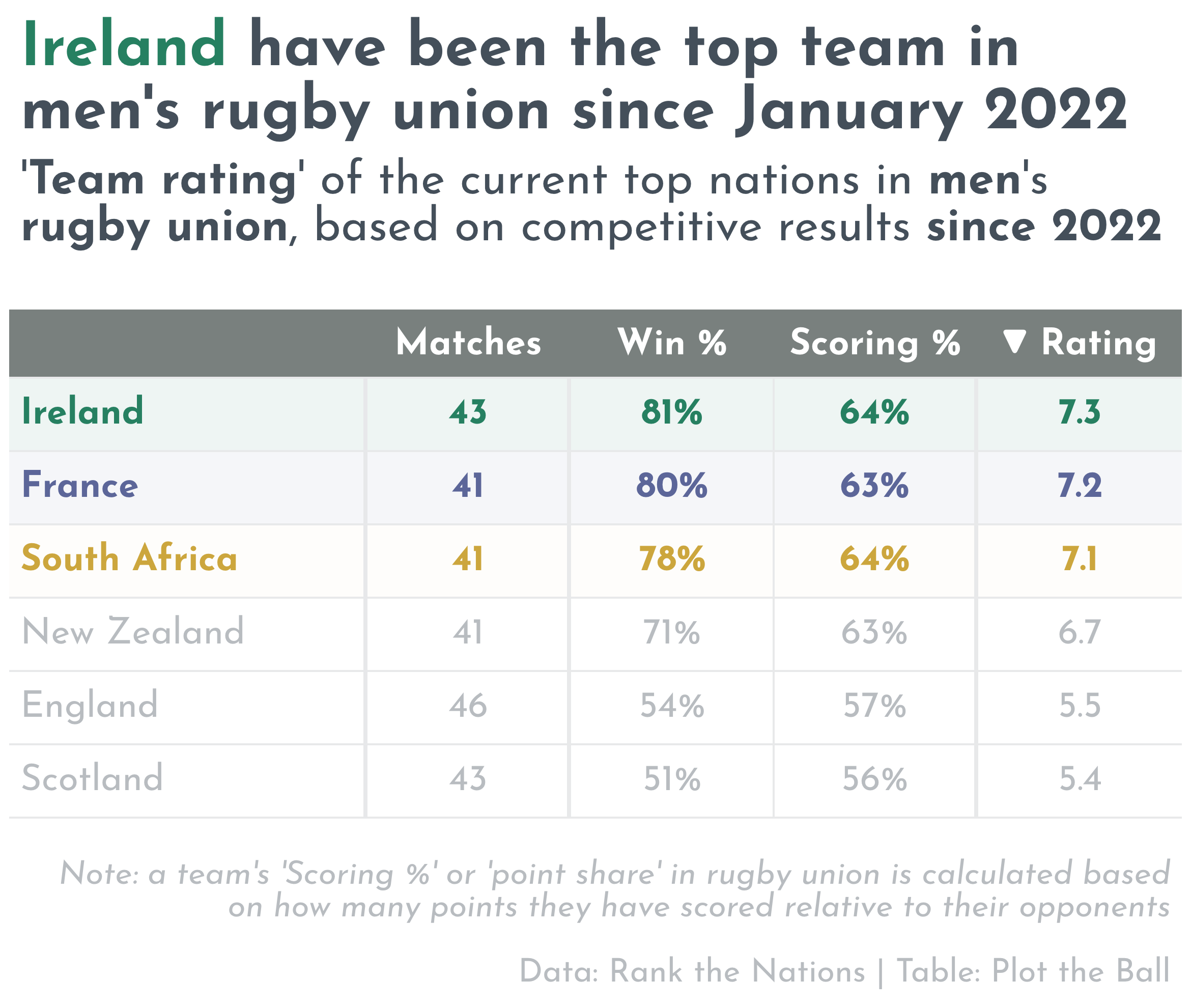
To see the impact of this new competitive structure, compare their win over Australia (3.5) this past weekend to their second fixture of the July window last year. (In both years, their first July fixture was impacted by the comparatively late finish of their domestic league season.) 12 months ago, France’s starting line-up contained players who in total had made only seven starts during the 2025 Six Nations; their team in Brisbane on Saturday combined for 20 in this year’s edition of the tournament.
📊 Chart of the week: Where is Russia’s sporting exile most notable?
The 30 team ball sports that I track for the ‘Rank the Nations’ project are overseen by 14 different official bodies, but on the question of Russia’s status in international competition they have been largely united since the invasion of Ukraine in 2022.
The last time the country appeared in my results database was on February 14th that year, when the Russian women’s basketball team beat Puerto Rico in a FIBA World Cup Qualifying Tournament. However, the International Olympic Committee ended its formal suspension of Russia last week; in the aftermath of that decision, it will be interesting to see if this cross-code unity holds. When the news came out, I was curious: in which sports had Russian teams been performing strongly before the war?
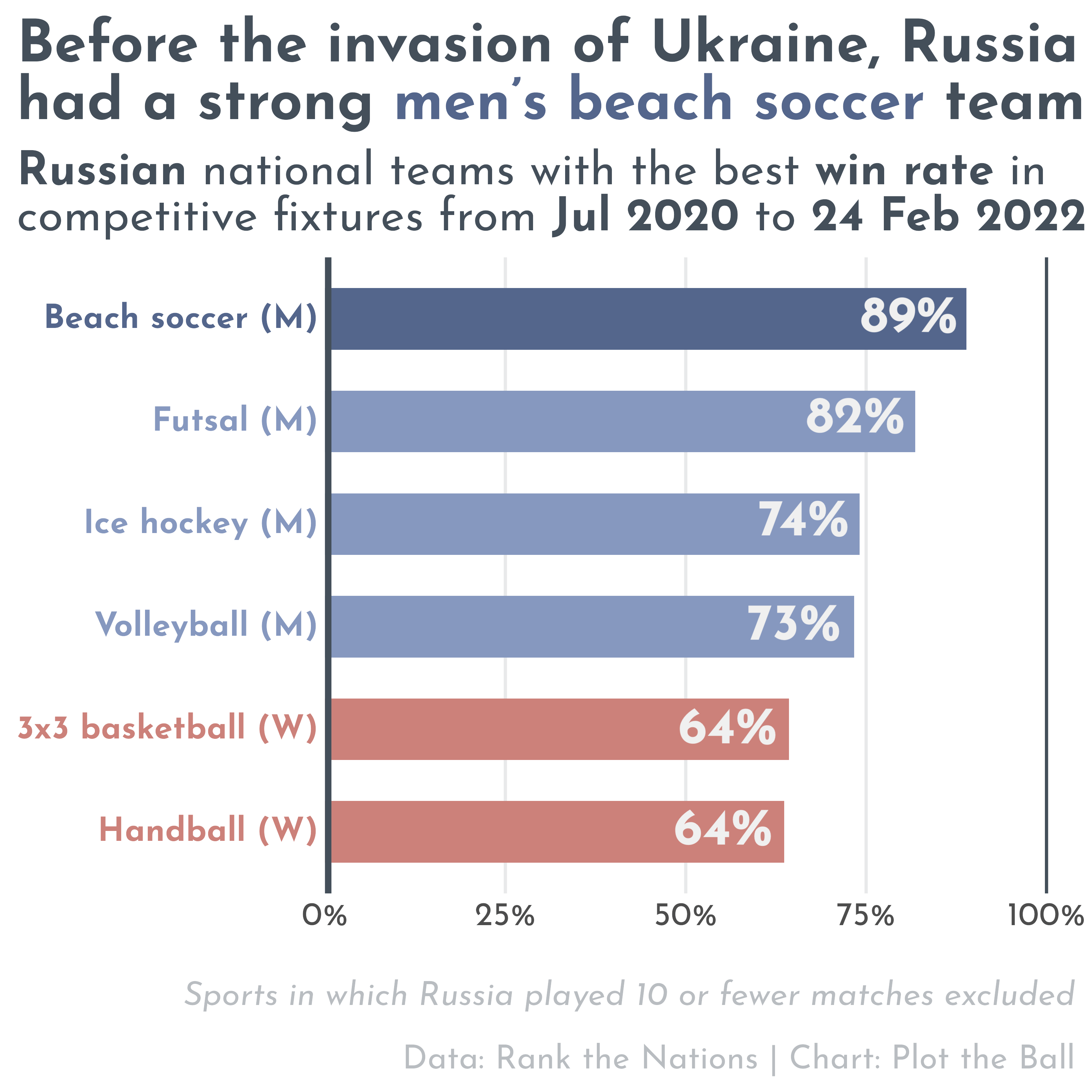
I might have guessed that ice hockey would appear near the top of this list: the men’s side had the third-best win rate of any Russian team from July 2020 until the invasion. The two above them were more surprising. Their men’s beach soccer team won the World Cup a third time in August 2021; then, on February 6th the next year, their men came second at UEFA Futsal Euro 2022. It made me a bit uncomfortable to learn that they reached the final — mere days before the war — by beating Ukraine in the semis.
⏪️ Highlight of the week: Jude Bellingham’s sense of destiny
Goals in soccer don’t always feel inevitable — but they do after Jude Bellingham has scored them. In England’s win over Norway on Saturday, it was their 23-year-old star who hunted down a rebound in extra time and swept it over the line. Who else?
In fairness, I wouldn’t have been surprised if it was Erling Haaland being lauded as a ‘killer’ today, had a loose ball happened to have fallen at his feet at the right time. And herein lies the issue for English fans: crucial goals feel inevitable when they’re scored by Lionel Messi of Argentina, too. Get past their semi-final opponents, and it might be Kylian Mbappé of France waiting for them in New York. It’s a sad fact of major international tournaments that there’s never quite enough destiny to go around.
You can watch a replay of this goal on YouTube here.
💭 What else I learned last week
For The Cutback, Callum McCarthy reported on a new investment deal struck by Liga F — the organisation that oversees the top level of women’s club soccer in Spain. He views it as “a huge commercial risk”: each club that has opted in will receive an up-front cash injection, but in exchange private investors will receive a considerable share of revenue going forward. The league is now seeking bidders for its media rights, having opted out of its existing broadcast deal a season early.
For Yahoo! Sports, Jeff Eisenberg wrote about the decision of Nikola Kusturica — a 17-year-old from Serbia — to play NCAA basketball next season instead of remaining with his EuroLeague club. He impressed in the recent FIBA U17 World Cup, scoring 37 points in a loss against the USA in the final, and some scouts consider him a contender to go first overall in the 2028 NBA Draft. How much money will he be paid in college? “[A] sizable amount," per Eisenberg’s reporting.
For Good Areas, Jarrod Kimber covered the England women’s team’s first ever day of test cricket at Lord’s. Before last week, they had played 55 home test matches across 10 decades — but not a single one at the ground widely known as the ‘home of cricket’. Most striking to Kimber were the differences between its typical audience and the fans who travelled across London to the game on Friday: “Even before you got to the ground, it was clear this was not a normal Lord’s Test.”
The next edition of the newsletter will be published on Monday July 20th.
